Will Elon Musk buy Spirit Airlines? Or will the Public Outbid him with Crowdfunding?
Published
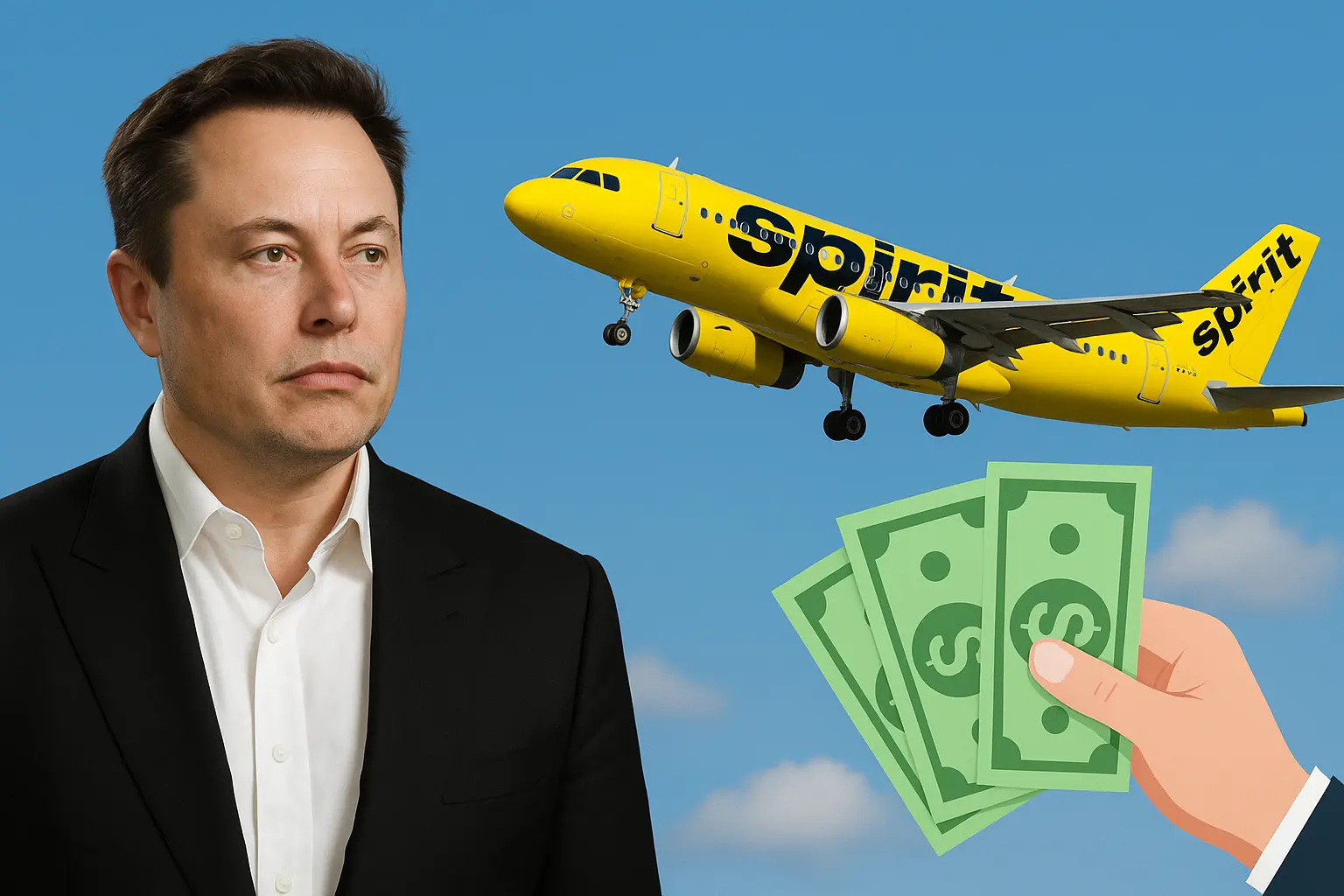
Elon Musk vs. The Internet: Who Will Actually Buy Spirit Airlines?
The Most Unusual Airline Auction in Aviation History
Spirit Airlines filed for bankruptcy in November 2024, and this week it shut down operations completely, becoming the first major U.S. ultra-low-cost carrier to collapse in decades. This legal and financial limbo created an opening that nobody predicted: a YouTube creator named Josh Richards launched a crowdfunding campaign to let ordinary people buy the airline collectively, and as of mid-2026, that campaign has raised over $23 million from tens of thousands of small investors who are genuinely tired of being treated like cargo.
At the same time, Elon Musk’s name keeps surfacing in aviation circles. The man already owns the world’s most valuable rocket company, a satellite internet network that covers 70 countries, and a social media platform he bought and rebuilt on his own terms. Buying a bankrupt airline with 140 planes and a famously battered brand would fit his pattern of acquiring distressed assets and making very loud, very public changes to them.
This article lays out both scenarios honestly. What would Musk actually do with Spirit? What would a crowd-owned airline even look like in practice? And underneath the novelty and the memes, which path leads somewhere real? The answer is more complicated, and more interesting, than either camp wants to admit.
The Musk Scenario: Disruption on a Budget Carrier’s Budget
The most likely version of an Elon Musk acquisition is not the one Spirit’s frequent flyers are hoping for.
Musk’s track record with acquisitions tells a consistent story. He bought Tesla when it was nearly bankrupt and turned it into the most valuable automaker on earth, but he did it by slashing the workforce, demanding brutal productivity, and centering everything on automation. He bought Twitter for $44 billion in October 2022 and immediately cut roughly 80% of the staff, from about 7,500 employees to somewhere around 1,500 within weeks. The platform survived, technically, though whether it thrived is genuinely debatable.
Apply that lens to Spirit, and the picture sharpens quickly. Spirit’s core problem was never its brand, which is admittedly terrible. Its problem was a cost structure that stopped being competitive. The airline’s attempt to merge with Frontier Airlines collapsed in 2022 when JetBlue made a higher bid, then JetBlue’s acquisition was blocked by the Department of Justice on antitrust grounds in January 2024. By November 2024, Spirit had no suitor and $1.1 billion in debt it could not service.
Musk would almost certainly see Spirit as an infrastructure play rather than an airline play. His instinct at every company he has touched is to strip out middle management, automate whatever can be automated, and then use the remaining lean operation as a platform for something bigger. In Spirit’s case, that “something bigger” could involve Starlink integration (every Spirit plane wired for in-flight internet overnight, at cost), a direct booking app with no third-party fees, and potentially using Spirit’s regional routes as a logistics network for other Musk ventures.
The part most articles miss: Spirit holds 145 flight slots at congested airports including Fort Lauderdale, Las Vegas, and Dallas. Those slots are arguably worth more than the planes. A buyer like Musk would not necessarily need to run Spirit as a functioning airline for it to be an excellent investment. He could reduce the fleet, monetize the slots, and rebuild around a skeleton route structure. Passengers would get cheaper Wi-Fi and a SpaceX-branded boarding experience. Whether they’d get more legroom or better customer service is doubtful.
One realistic outcome, based on how Musk handled Twitter, is a roughly 40% reduction in Spirit’s ground staff, heavier automation in check-in and baggage, and a rebrand that leans into the “budget and proud of it” positioning rather than apologizing for it. Spirit has always been honest that it’s selling a seat, not an experience. Musk might find that refreshingly compatible with his worldview.
The risk, and it’s a real one, is labor. Spirit’s pilots are represented by the Air Line Pilots Association, and flight attendants have their own union contracts. Aviation is among the most heavily regulated industries in the United States. The FAA doesn’t bend for billionaires. Musk’s confrontational approach to organized labor, well-documented at Tesla’s Fremont factory, would hit a wall in an industry where a single work stoppage can ground an entire fleet and where federal safety regulators have real enforcement teeth.
The Crowdfunding Scenario: Beautiful Idea, Brutal Math
Raising $23 million sounds impressive until you look at what a bankrupt airline actually costs.
Josh Richards, a creator with millions of followers across TikTok and YouTube, launched the “Buy Spirit Airlines” campaign with genuine enthusiasm and a compelling pitch: what if the people who ride the planes owned the planes? It’s a romantic idea, and the speed at which it raised money, crossing $20 million within weeks, showed that the frustration with corporate air travel is real and deep.
The problem is the gap between $23 million and what Spirit actually needs.
Spirit’s bankruptcy reorganization involves roughly $795 million in debt obligations to secured creditors, plus lease obligations on its Airbus A320 family fleet, plus pension commitments, plus operating costs during any transition period. Aviation analysts tracking the bankruptcy proceedings put the realistic acquisition price somewhere between $400 million and $600 million for the airline as a going concern. Even at the very low end, the crowdfunding campaign would need to raise roughly 17 times what it has currently collected.
That is not impossible in theory. GoFundMe campaigns have raised nine-figure sums for disaster relief. But disaster relief donors don’t expect a return on their money, and the Spirit crowdfunding participants presumably do. The legal structure required to convert thousands of small donations into actual equity ownership is genuinely complex. You’d need to form an entity, likely a cooperative or a special purpose vehicle, file with the SEC if shares are offered to the public, satisfy bankruptcy court requirements for a qualified bidder, and then actually operate a federally regulated airline while managing a shareholder base that could number in the hundreds of thousands.
The closest real-world parallel is REI, the outdoor retail cooperative founded in 1938, which is owned by its 22 million members and generates about $3.8 billion in annual revenue. REI works because retail cooperatives are legally straightforward, and because members vote on relatively simple decisions. Running an airline with a cooperative governance model would require every major operational decision, route changes, fare pricing, labor negotiations, fleet investment, to survive a diffuse ownership structure that has never been tested in commercial aviation.
The counter-intuitive insight here is that the crowdfunding campaign might be more valuable as a political story than as an actual acquisition vehicle. If it forces Congress to hold hearings about airline consolidation, or pressures the Biden-era DOJ’s successor to look differently at future mergers, or simply demonstrates that consumer frustration with air travel has reached a boiling point, the $23 million may punch well above its financial weight without ever buying a single plane.
Capitalism vs. Socialism at 35,000 Feet: What This Showdown Actually Reveals
This is where the Spirit situation becomes genuinely interesting as a cultural moment, not just a business story.
The Musk scenario represents a specific flavor of capitalism: the distressed-asset acquisition, where a wealthy buyer extracts value from a failed company by cutting costs aggressively, using existing infrastructure for new purposes, and betting that a leaner version of the operation can survive where the bloated original couldn’t. It’s not evil. It works often enough that serious investors do it constantly. It also tends to be brutal for employees and produce mixed results for customers.
The crowdfunding scenario represents something that’s not quite socialism in the technical sense, since socialism involves state ownership rather than collective private ownership, but is absolutely a reaction to the perceived failures of shareholder-first capitalism. The argument is essentially: the people who use this airline every week have more legitimate standing to shape its future than a hedge fund that bought distressed debt. That argument is emotionally compelling and structurally difficult.
What’s fascinating is that both camps are responding to the same real failure. Spirit collapsed because the airline industry’s cost structure is deeply broken. Ultra-low-cost carriers win customers on price but lose them on experience, and when a competitor like Southwest has a bad year or fuel prices spike, the margin for error on a Spirit-style model essentially disappears. Neither Musk’s slash-and-automate approach nor a crowd cooperative automatically fixes that structural problem.
The honest answer is that the aviation industry needs neither a savior billionaire nor a meme-powered crowdfund. It needs better antitrust enforcement, more competition on key routes, and fare transparency regulation that the DOT has been slowly moving toward. Spirit’s bankruptcy is a symptom. The disease is an oligopoly where four airlines (American, Delta, Southwest, United) control roughly 80% of domestic U.S. air traffic.
What You Can Actually Do With This Information
If you own Spirit credit card points or have a future Spirit booking, check the airline’s current operational status regularly through the DOT’s consumer protection page (transportation.gov) and Spirit’s own website. Bankruptcy protection means flights are still operating, but the situation can change quickly and knowing your consumer rights matters. Under DOT rules, if Spirit cancels a flight, you’re entitled to a full cash refund, not just a credit.
If the crowdfunding campaign interests you as a participant or just as a phenomenon worth watching, search for “Buy Spirit Airlines” on Josh Richards’ YouTube channel and read the campaign’s terms carefully before contributing anything. Pay specific attention to whether the campaign is structured as a donation, a pre-purchase of equity, or something else entirely. That distinction determines both your legal rights and your tax situation.
If you’re watching this as an investor or just as someone curious about how the bankruptcy resolves, the place to follow it is the U.S. Bankruptcy Court for the District of Delaware, where Spirit’s case is filed. Court documents are public and often more revealing than press coverage. Major bids or reorganization plans will surface there first.
Where This Is Heading
A traditional private equity buyer, possibly one you’ve never heard of, is statistically the most likely outcome. That’s how most airline bankruptcies end: not with a dramatic savior but with a quiet restructuring that keeps some routes, kills others, and produces an airline that’s slightly smaller and slightly more solvent.
Musk buying Spirit is possible but not probable. He has plenty on his plate, and aviation is uniquely resistant to his preferred management style. The crowdfunding campaign is inspiring and almost certainly insufficient on its own, though it could evolve into something more sophisticated with the right legal and financial architecture around it.
The real question this situation leaves open is whether Americans are ready to seriously experiment with cooperative ownership models in industries they depend on. Worker-owned airlines exist elsewhere in the world. Consumer cooperatives run entire grocery chains. The frustration driving those $23 million in small donations is real and it’s not going away, regardless of what happens to Spirit’s gates at Fort Lauderdale.
What would you actually change if you owned 0.0003% of an airline? That’s not a rhetorical question. It’s the one the Spirit crowdfunding participants are going to have to answer if this gets any further.
Worth sharing?
Send this to someone who would find it useful.