Why We Love Pumpkin Spice: The History, Science and Ritual of Fall's Favorite Flavor
Published
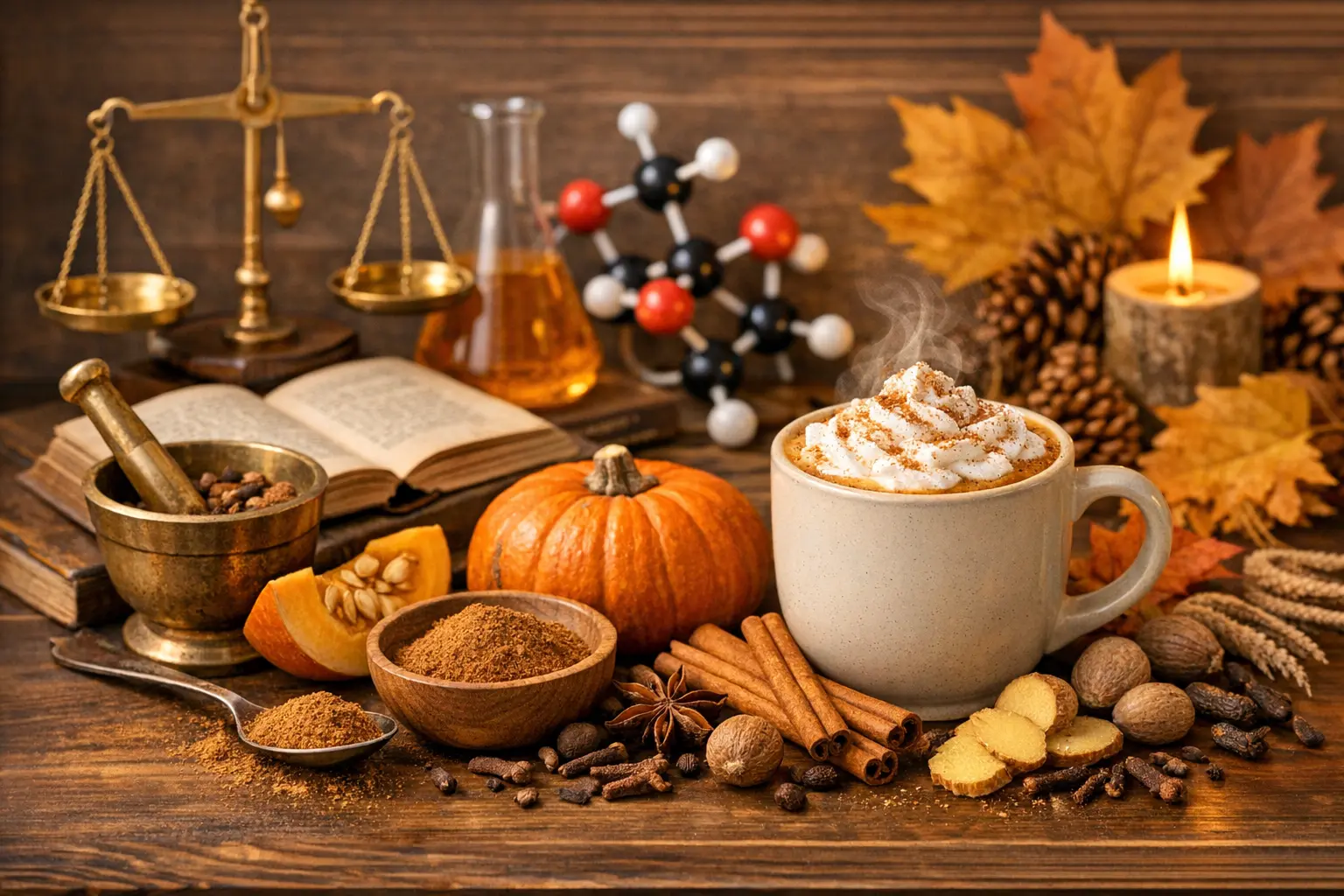
Open a jar of pumpkin pie spice and smell it. Cinnamon first, then the warm bite of ginger, then nutmeg, and maybe a dark note of clove or allspice. No pumpkin. The jar almost certainly doesn’t contain any.
The orange gourd on the label is standing in for a memory. The blend brings together plants with origins across Asia and the Americas, far beyond a New England pumpkin patch. The squash was grown in the Americas for thousands of years before a European tasted it. And the paper cup that helped make “pumpkin spice” a household phrase is only about twenty years old.
To understand why that cup feels like autumn, start with a distinction that matters both to the history and to your next pie.
The Canned Pumpkin Aisle
Stand in front of the canned pumpkin at any grocery store in October and you’ll see the problem. Two cans, same orange, same leafy font, sitting shoulder to shoulder. One is plain puree. The other is pie filling, already sweetened and spiced. They look interchangeable. They are not.
“Pumpkin spice” names a flavor memory, not an ingredient. It’s shorthand for the spices people traditionally put in pumpkin pie, and it says nothing about what’s inside the pumpkin. So here are the four orange things people mix up.
Pumpkin is the fruit itself (botanically a fruit, since it holds seeds). It belongs to the Cucurbita genus, along with zucchini and butternut squash. The flesh is mild, a little earthy, faintly sweet. Nobody would call it spicy.
Plain pumpkin puree is cooked, mashed pumpkin and nothing else. A can that says “100% pumpkin” should list only pumpkin. Check the ingredients rather than judging by the picture on the label.
Pumpkin pie filling (sometimes “pumpkin pie mix”) is puree that’s already sweetened and spiced. The can is designed to become a pie if you follow the recipe printed on its label. For example, Farmer’s Market Organic Pumpkin Pie Mix, three 15-ounce cans #ad combines pumpkin with sugar and spices. This is a three-can pack, and it still needs the additional ingredients specified in its recipe; it is not an unsweetened purée.
Pumpkin pie spice is a dry blend. Cinnamon, ginger, nutmeg and allspice or cloves are the usual core. Some add mace or cardamom. Recipes vary.
Put pie filling in a muffin recipe that already has sugar and spice and you get something cloying and overspiced. Put plain puree in a recipe written for pie filling and the pie comes out bland. If you buy the pie filling, follow the recipe on that can. If a recipe says “pumpkin puree,” buy the can whose ingredient list says only pumpkin.
Tomatoes, tomato paste, ketchup. Same ancestor, and you wouldn’t pour ketchup into a stew and expect tomato.
Thousands of Years Before the Latte
The pumpkin half of this story belongs to the Americas, and it is much older than the pie. Indigenous communities cultivated squash for thousands of years before European colonization. Archaeological research in Mexico documents domesticated squash in early farming contexts; a study held in the Smithsonian repository describes evidence from the Central Balsas region dating back at least 8,700 years. That is a history of food cultivation, not of lattes or dessert seasoning.
By the time European colonists showed up, squash was part of a sophisticated farming system. Many Indigenous nations, including the Haudenosaunee (Iroquois), grew corn, beans and squash together, a combination often called the Three Sisters. The corn gave the beans a pole to climb, the beans enriched the soil, and the broad squash leaves shaded the ground and helped keep weeds down. People ate squash fresh and roasted, dried it in strips for winter, and ate the seeds too. It was a staple, not a dessert.
Colonists in New England learned to grow these squashes where familiar European crops sometimes struggled. The Library of Congress’s history of pumpkin pie in America points to a 1655 account that already mentions pumpkin pies among the colonists. So pumpkin went from Indigenous fields into colonial baking within a few decades of English settlement. Who baked the first one is lost. Pumpkin was cooked a lot of ways before it settled into a crust, and nobody wrote down the moment.
Roast a small pie pumpkin once. Halve it, scoop the seeds, roast it cut side down until a fork slides in. Taste a spoonful plain, then with a pinch of salt and a little butter. Most people are surprised how gentle it is. Pumpkin is less the star of pumpkin pie than the stage it’s performed on.
When Spice Ships Met an American Squash
None of the classic pie spices are native to New England. Cinnamon came largely from Sri Lanka. Nutmeg, and mace (its lacy outer covering), came from the tiny Banda Islands in what is now Indonesia, which Europe’s spice traders fought over bitterly for centuries. Cloves came from the Moluccas, ginger from tropical Asia.
Allspice is the odd one out. It’s the dried berry of a tree native to the Caribbean and Central America, so the one “exotic” spice in many pumpkin blends is as American as the pumpkin. The name comes from the way it seems to taste like cinnamon, nutmeg and clove at once.
English cooks already had a long tradition of spiced puddings, custards and pies built on these imported spices. Combine that habit with abundant local squash and spiced pumpkin custard was close to inevitable. An especially useful early printed example is in American Cookery by Amelia Simmons, published in 1796 and generally described as the first cookbook by an American author printed in the United States. The full text is free on Project Gutenberg.
Plenty of articles get her wrong in one of two directions. Some call Simmons the inventor of pumpkin pie. Others say she invented pumpkin spice. She did neither. Pumpkin pies were being described in the 1600s, and spiced custards were an old English idea. What she gives us is a snapshot of how Americans were actually cooking pumpkin at the end of the eighteenth century, and the snapshot is better than the myth.
She gives two recipes, both spelled “pompkin,” both called puddings, though both are baked in a crust, which is what we’d call a pie. The first starts with stewed and strained pumpkin and enriches it with cream, plenty of eggs and sugar, seasoned with mace, nutmeg and ginger. The second is plainer: milk, pumpkin, fewer eggs, molasses, with allspice and ginger.
Side by side, it’s obvious there was no fixed “pumpkin spice” formula. One leans on mace and nutmeg. The other leans on allspice and ginger and gets its sweetness and dark color from molasses. Neither mentions cinnamon, which many modern blends lead with. They read like a cook’s working notes, adjusted to the pantry and to how rich a household could afford to make dessert. The contrast shows two approaches, rather than a single recipe that every household followed.
That variability survives. Every brand and family recipe balances the spices a little differently, so “pumpkin spice” from one jar can taste noticeably different from another.
You can explore that difference without reproducing an eighteenth-century recipe. Try a modern pumpkin recipe designed for molasses and ginger, then compare it with a more cinnamon-forward version. The fruit can stay the same while the aroma and sweetness change substantially.
How a Pie Became a Holiday, and a Blend Became a Jar
Pumpkins ripen in early fall and store well into winter, so they were plentiful just when New England families gathered for harvest celebrations and Thanksgiving dinners. A food that’s abundant at a festive time tends to become the food of that festival.
Poetry nailed it down. In 1844, the writer and abolitionist Lydia Maria Child published “Over the River and Through the Wood,” about a family’s sleigh ride to a grandparent’s house for Thanksgiving. Generations of schoolchildren later sang it, often reworked as a Christmas song. The original ends on the pie: “Hurra for the fun! Is the pudding done? Hurra for the pumpkin-pie!” In a few stanzas it fuses the journey, the cold air, the reunion and the pie into one feeling. Few foods get that kind of framing.
Two decades later, after a long public campaign by the magazine editor Sarah Josepha Hale, President Abraham Lincoln proclaimed a national day of Thanksgiving in 1863. As Thanksgiving became a fixed national holiday, pumpkin pie went with it beyond New England and became the expected end of the meal across much of the country.
Then came convenience. Canned pumpkin meant you didn’t have to wrestle a whole squash. Premixed spice blends meant you didn’t have to open four or five separate jars. McCormick dates its pumpkin pie spice blend to 1934. That is a milestone in packaged convenience, not the invention of spiced pie: cooks and merchants had been mixing spices long before it. What a widely sold, ready-made blend does is standardize the flavor. When millions of households use similar proportions, “pumpkin spice” stops being a family’s way of seasoning pie and becomes a recognizable, repeatable taste. Think of a pop song everyone learns from the same recording, versus a folk song that changes from village to village.
The jar is also the most flexible way to use the flavor at home. Simply Organic Pumpkin Spice, 1.94 oz #ad is one dry-blend option for the pantry. Ground pumpkin pie spice is the workhorse: about 1/4 teaspoon in oatmeal with your usual sweetener, a pinch in pancake batter, tossed with roasted sweet potatoes or squash and a little maple syrup. Canned pie filling is the quickest route to a classic pie, and since the sugar and spices are already in there, treat the label recipe as gospel. Krusteaz Pumpkin Spice Muffin Mix, six 15-ounce boxes #ad offers a baking shortcut, with real pumpkin in the mix. The linked package contains six boxes, so it makes more sense for repeated baking or sharing than for someone who wants just one batch. Follow the package directions, and let children compare the aroma of the dry spices with the finished muffins. Cookies made with a little pumpkin-pie spice offer another way to carry the same flavor beyond pie.
Ground spices lose aroma over time, especially near a warm stove. If your blend smells faint when you open the jar, it’ll taste faint in the pie. Keep the jar tightly closed somewhere cool and dark. A faint aroma is a reason to replace a tired blend, not to ignore signs of moisture, spoilage, or damaged packaging.
From Pie Plate to Paper Cup
The modern craze is a coffee-shop phenomenon layered on top of the pie tradition. According to Starbucks’ published history, the company developed the Pumpkin Spice Latte in 2003. The idea underneath is simple: take the flavor of the dessert at the end of Thanksgiving dinner and put it in the coffee people already drink every morning.
Timing did the rest. A drink that shows up only in late summer or fall turns a flavor into an event. The return of the seasonal menu works as a small announcement that the season has changed, and the drink’s eventual disappearance gives it a deadline. Food companies borrowed the formula and pumpkin spice spread to cereals, creamers, snacks and plenty of other things. The jokes and the backlash spread just as fast, which tells you how familiar the flavor had become.
A café latte is a very different thing from the spice in your jar, and the gap trips people up at home. A coffee-shop pumpkin spice drink is mostly a sweetness-and-texture experience: sugar, milk, foam and aroma. The spice blend alone is dry, slightly bitter and unsweetened. Sprinkle it into black coffee expecting a latte and you’ll be disappointed. The spice alone cannot supply the sweetness or creamy texture.
The home options differ more than the labels suggest:
- Pumpkin-flavored ground coffee, such as New England Coffee Pumpkin Spice Ground Coffee, 11 oz #ad, takes the brew-at-home route. You brew it like ordinary coffee and get aromatic coffee with a hint of spice. It is not a ready-made latte: brewing flavored grounds does not add the milk, foam, and syrup of a café drink. Adjust those separately to your taste.
- Pumpkin spice syrup, such as Torani Pumpkin Spice Syrup, 25.4 fl oz with pump #ad, adds sweetness and flavoring together. It’s usually thin and pourable, and it isn’t the same as the thick pumpkin “sauce” some cafés use, which often contains pumpkin and sweetened condensed milk. Start with a teaspoon or two and taste.
- Pumpkin coffee creamer, such as Coffee mate Pumpkin Spice Creamer Singles, 200-count box #ad, often adds sweetness and creaminess at once, so read the label before you also add syrup or sugar, or the drink ends up sweeter than you planned. This is a bulk box of shelf-stable single-serve tubs, not a refrigerated bottle. Do not assume a shelf-stable or “non-dairy” creamer is free of milk allergens; check the ingredient list and allergen statement. Refrigerated creamers need to stay cold, so if you order one online, make sure it ships with proper cold handling.
- Ground spice alone won’t dissolve. It settles into a gritty sludge. Use 1/8 to 1/4 teaspoon per cup, and either mix it into the grounds before brewing or whisk it into warm milk first.
If you are starting with espresso rather than brewed coffee, our Americano guide explains the coffee-and-water base. Before you blame the coffee, check the sweetness. Many people who say homemade pumpkin spice coffee “tastes wrong” are really missing the sugar and fat that carry the flavor in a café drink.
Why It Smells Like Fall
Much of what we call flavor is actually smell. Your tongue detects basic tastes: sweet, salty, sour, bitter, savory. Your sense of cinnamon or nutmeg comes largely through your nose, both from sniffing and from aromas that rise up the back of your throat as you eat and drink. That’s why food tastes flat when you have a stuffy nose. Pumpkin spice is an aroma-heavy flavor, which is part of why a candle can evoke it almost as well as a pie.
Smell is also tied closely to memory. In a 2004 study, psychologist Rachel Herz compared personal memories cued by smells, sights and sounds associated with campfires, fresh-cut grass and popcorn. Odor-cued memories were more emotional and evocative, but were not more vivid or specific. The experiment did not test pumpkin spice. It supports a broader explanation for why a familiar aroma can feel emotionally meaningful, not a claim that this particular blend affects everyone the same way. If cinnamon and nutmeg reliably filled your childhood kitchen in November, that smell can work later like a bookmark that opens straight to those pages.
Several explanations probably overlap. Learned associations do much of the emotional work: for many people these spices have been paired for years with holidays, family meals and cooler weather. Warm spices also smell like something in the oven, which suggests comfort and someone cooking for you. Then there’s the backstory most of us absorbed before we ever ordered the drink, like Thanksgiving pie and school songs such as Child’s poem. And anticipation counts for something. A thing that vanishes for most of the year feels special when it returns, and its return marks the turn of the season.
For someone who grew up around pumpkin pie, the aroma may signal a season as much as a flavor. For someone without those associations, it may simply smell like a pleasant spice mixture, or not be appealing at all. Those different reactions fit an explanation based on experience and culture; they do not make liking or disliking the drink a measure of sophistication.
What the evidence does not support is a universal biological “pumpkin spice addiction,” or any claim that the flavor works on your brain chemistry in some special way. You’ll see that in plenty of breezy articles. It makes a better headline than the science. The real explanation is also the more interesting one: a flavor became meaningful because people kept sharing it at meaningful times.
Making It Yours
Blend your own. A common starting ratio: 3 tablespoons ground cinnamon, 2 teaspoons ground ginger, 2 teaspoons ground nutmeg, 1 teaspoon ground allspice, 1 teaspoon ground cloves. Mix in a small jar, then taste a pinch in warm milk with a little sugar and adjust. Want to cook closer to 1796? Add a little mace and cut the cinnamon. If clove reads as medicinal to you, halve it. Within an afternoon you’ll know your preferred balance better than any label can tell you.
Read every pumpkin label once. Pick up a can of plain puree and a can of pie filling and compare the ingredient lists. Do the same with a creamer and a syrup, noting where sugar appears and whether dairy is listed. Five minutes, and it saves you a ruined pie and an accidentally syrupy coffee for years.
Start a tradition on purpose. You do not need to inherit the Thanksgiving connection to enjoy a seasonal ritual. Pick one recurring moment (the first cold Saturday, the week before Thanksgiving, a friend’s October birthday) and bake the same pumpkin muffins or pie every year. The repeated occasion gives the food a personal setting of its own.
A Ten-Minute Tasting
Set out four small cups. In the first, a pinch of ground pumpkin pie spice. Just smell it. In the second, whisk the same pinch into warm milk with a teaspoon of sugar. In the third, plain brewed coffee with a splash of pumpkin spice syrup or creamer. In the fourth, a spoonful of plain roasted or canned pumpkin.
Smell the dry spice; taste the other samples. Note what you smell first, how sweet each one is, and how it feels in your mouth. Does the flavor you call “pumpkin” come through most strongly in the actual pumpkin, or in the spiced drink? Then ask everyone at the table which sample smells most like fall, and why. The history becomes more interesting when you can taste the distinctions for yourself.
Sources
- Library of Congress, “Inside Adams” blog, “A Brief History of Pumpkin Pie in America” (2017): https://blogs.loc.gov/inside_adams/2017/11/a-brief-history-of-pumpkin-pie-in-america/
- Amelia Simmons, American Cookery (1796), Project Gutenberg edition: https://www.gutenberg.org/ebooks/12815
- Smithsonian repository, early maize and squash domestication research: https://repository.si.edu/handle/10088/14853
- Lydia Maria Child, “Over the River and Through the Wood” (1844), discussed in the Library of Congress source above
- Food & Wine, “Pumpkin Spice Didn’t Start at Starbucks” (packaged spice-blend history): https://www.foodandwine.com/lifestyle/pumpkin-spice-history
- Starbucks, “Pumpkin Spice Latte” brand history (company account): https://about.starbucks.com/history/pumpkin-spice-latte/
- Herz, R. S. (2004). A naturalistic analysis of autobiographical memories triggered by olfactory, visual and auditory stimuli. Chemical Senses: https://pubmed.ncbi.nlm.nih.gov/15047596/