Why Human Creativity is the Ultimate Luxury in an Automated Age
Published
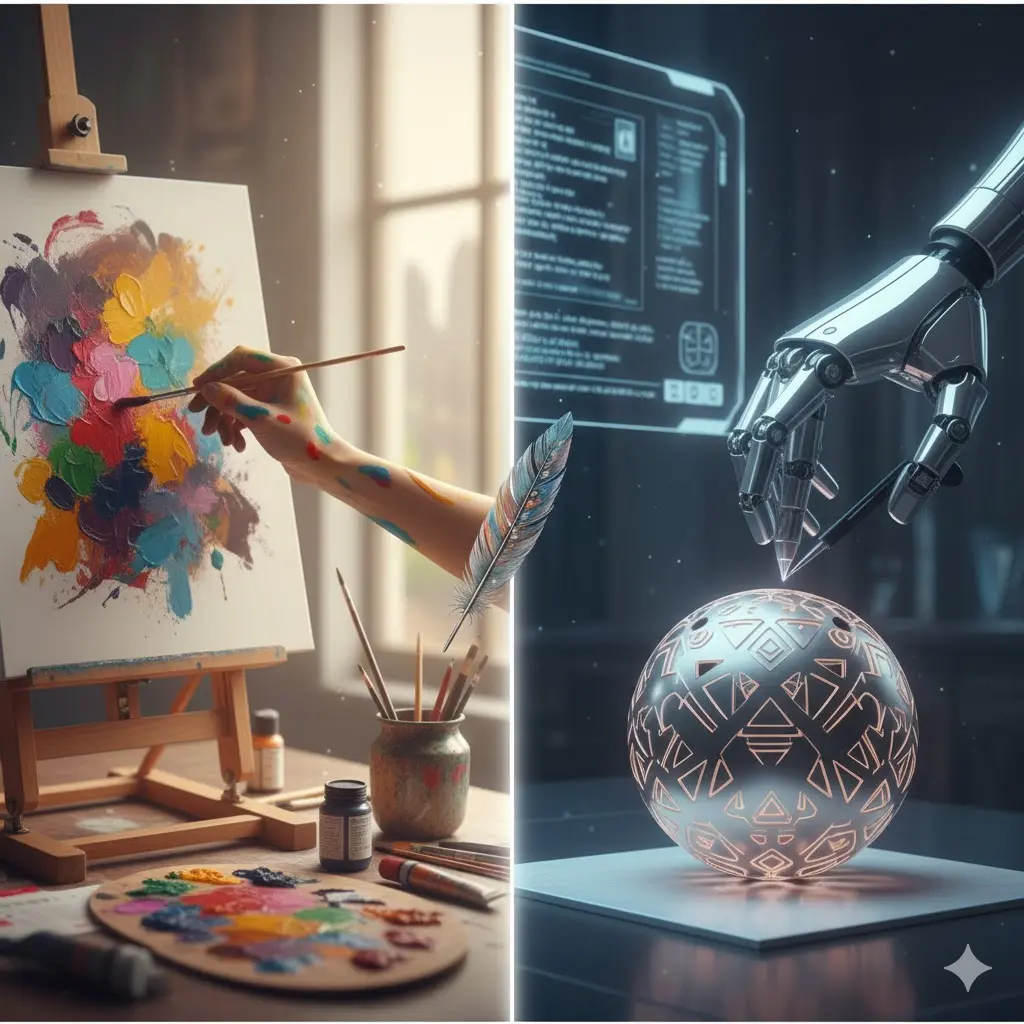
Why Human Creativity is the Ultimate Luxury in an Automated Age
Walk into any modern workplace and you can feel it: the quiet hum of automation. AI writing tools spin up drafts in seconds. Design software generates layouts on command. Recommendation engines decide what we watch, buy, and read. Even strategy decks and code scaffolding can be produced in a lunchtime.
And yet, the more the world automates, the more valuable one stubbornly human thing becomes: real creativity.
Not “creativity” as in a motivational poster. Not the kind that’s basically copying what already works with a new font. I mean the kind of human creativity that creates new categories, new stories, new tastes, new movements, and new meaning. The kind that makes people feel something. The kind that pulls a future into the present.
In an automated age, human creativity becomes a luxury for the same reason handmade watches, bespoke suits, and private chefs are luxuries. Not because machines can’t produce output. They can. It’s because rare, intentional, deeply human work becomes scarce, and scarcity is what markets, culture, and attention reward.
Automation Made Output Cheap. That Changes Everything.
For most of modern history, “making” was expensive. Writing took time. Designing took training. Editing took patience. Producing videos required gear and crews. Software development demanded specialists. Creative output was constrained by labor, tools, and access.
Generative AI and automation flipped that.
Today, a single person can publish more content in a week than a 20-person team could a decade ago. Brands can churn out endless variations of ads. Publishers can commission 100 articles and A/B test headlines until something sticks. Startups can prototype a product in days.
That’s the promise and the problem.
When output becomes cheap, average becomes invisible. And when average becomes invisible, the world starts paying attention to what feels unmistakably human: originality, taste, voice, emotional truth, lived experience, and judgment under uncertainty.
This is why “AI-generated” is increasingly treated like “mass-produced.” It’s not necessarily bad. It’s just not special.
Luxury, in the end, is often the ability to choose what is special.
The New Status Symbol Isn’t More Content. It’s Better Taste.
We’re moving from an information economy to a discernment economy.
When everyone can generate competent copy, competent copy stops being a competitive advantage. When everyone can generate logos, logos stop being identity. When everyone can generate a thousand ideas, ideas stop being scarce.
So what’s scarce?
Taste. Curatorial intelligence. The ability to know what matters, what resonates, what to keep, what to remove, and when to break the rules.
Taste is not a template. It’s a muscle built through context: years of reading, building, failing, listening, noticing patterns, and understanding people. Taste is the difference between a song that sounds like every other song and a song that changes what people think a song can be.
You can automate production. You can’t automate conviction.
And in markets where options are infinite, conviction is priceless.
Human Creativity Has “Friction,” and Friction Is the Point
Automation optimizes for speed and scale. Human creativity often looks like the opposite. It can be slow. Inefficient. Emotional. It involves dead ends, awkward drafts, and irrational leaps.
But that friction is exactly where meaning is made.
A machine can produce a “good enough” paragraph on demand. A human can write a paragraph that carries a life inside it. The difference is not grammar. It’s experience. It’s the ability to translate an inner world into something another person recognizes as their own.
That’s why the most memorable creative work usually contains a trace of struggle. Not melodrama. Just evidence that someone risked something. That someone chose a specific point of view, and paid for it with time and attention.
In an automated age, the willingness to spend time becomes a signal of value.
That is luxury.
Why AI Can’t Replace the Most Valuable Part of Creativity
Let’s be clear: AI can be incredibly useful in creative workflows. It can accelerate ideation, expand options, and reduce tedious tasks. For professionals, it can be a powerful assistant.
But when people talk about “AI replacing creativity,” they usually mean replacing the outputs we associate with creativity: words, images, melodies, layouts.
The most valuable part of creativity is not the output. It’s the underlying act of human judgment and intention.
Here are the parts that remain stubbornly human:
1) Creating new meaning, not just new combinations
Generative models remix patterns from past data. Humans create meaning that responds to a living moment. They can sense what the culture is hungry for, what it’s tired of, and what it doesn’t yet have language for.
2) Taking responsibility for a point of view
A lot of AI content feels safe because it’s optimized to be broadly acceptable. Human creators take a stance. They risk being wrong, or disliked, or misunderstood. That risk is often what makes the work matter.
3) Understanding the room
Real creativity is not created in a vacuum. It’s relational. It understands context, politics, timing, subtext. A joke lands because the audience is ready. A product succeeds because it meets a real human tension. A story changes someone because it arrives at the right time in their life.
4) Building trust through authenticity
People don’t just buy products. They buy narratives, identity, and affiliation. In a world flooded with synthetic media, authenticity becomes a competitive moat. Not “authentic” as a marketing trick, but authentic as in consistent, lived, earned.
AI can imitate a voice. It can’t live the life that gave the voice its weight.
The Luxury Shift: From Access to Attention
Luxury used to be about access. Private clubs. Exclusive events. Scarce goods. In a digital world, access is everywhere. Tutorials are free. Tools are cheap. Distribution is instant. You can learn almost anything from your phone.
So the definition of luxury is shifting again.
Now luxury is attention: the ability to focus, to go deep, to make something careful while everyone else is rushing. It’s the ability to protect time from the constant churn of notifications and algorithmic pressure. It’s the ability to produce fewer things that matter more.
This is why the creators who stand out in an automated age aren’t necessarily the ones who post the most. They’re the ones who build a recognizable perspective. They develop a signature. They don’t just produce. They author.
And authorship, in a sea of automation, becomes rare.
Real-World Examples: Where Human Creativity Is Already Winning
Look at where the money and attention are going.
In marketing, campaigns that feel overly optimized often blend into the feed. The work that breaks through tends to be weird in a specific way. It carries a human fingerprint. The kind of ad that makes you pause, laugh, argue, or share.
In product design, software can generate interfaces, but it can’t easily generate the feeling of being understood. The most beloved products aren’t just functional. They reflect empathy and a philosophy. They make trade-offs. They have an opinion about how life should feel.
In entertainment, audiences are already overwhelmed by content. The winners are not the highest-volume studios. They’re the stories that create cultural moments. The shows and films that spark conversation because they say something true, or forbidden, or newly visible.
In luxury goods themselves, craftsmanship is returning as a differentiator. Not because industrial production disappeared, but because the human touch signals care. The imperfections become proof of life.
Even in business strategy, what executives pay for isn’t information. It’s judgment. Everyone has the same dashboards. The scarce skill is knowing what to do with them, and having the courage to do it.
Creativity as a Form of Wealth
Here’s a quiet truth: creativity isn’t just an artistic trait. It’s a form of wealth.
If you can create novel solutions, tell compelling stories, and invent new ways of seeing, you can adapt in almost any economy. Automation threatens routine work first, but it rewards the people who can redesign the routine, reframe the problem, or imagine the next market.
This is why “creative thinking” and “human creativity” are showing up in every serious conversation about the future of work, AI disruption, and career resilience. Not as a feel-good line, but as a survival skill.
In the automated age, creativity becomes a kind of economic leverage. It’s how you stop competing on speed and start competing on originality.
The Counterintuitive Truth: Automation Can Make Humans More Creative
There’s a cynical narrative that AI will drain the world of artistry. I don’t buy it. What I see, working with real teams and real businesses, is something more nuanced.
When automation removes the mechanical parts of a process, it can free humans to spend more time on the parts that actually require humanity: the concept, the story, the emotional arc, the ethical line, the final decision.
But only if we choose that.
If we use automation to increase volume, we get more noise. If we use automation to increase depth, we get more meaning.
The luxury is in choosing depth.
How to Practice “Luxury-Level” Creativity (Without Becoming Precious)
Luxury creativity is not about being slow for the sake of it. It’s about being deliberate.
It looks like researching before reacting. It looks like writing something you believe, not something that will merely perform. It looks like developing taste by studying the best work, then taking the risk to depart from it. It looks like editing aggressively, because clarity is kindness and signal matters.
It also looks like protecting your attention. The most expensive input in modern creativity is not software. It’s uninterrupted thought.
And yes, it can include AI tools. The point is not to reject automation. The point is to refuse to outsource your mind.
Use the tools. Keep the authorship.
The Future Belongs to the Unautomatable
As automation expands, the baseline rises. Competence becomes table stakes. The internet fills with decent articles, decent images, decent ideas.
So the question changes from “Can you make something?” to “Can you make something that couldn’t have been made by anyone else?”
That’s the heart of why human creativity is the ultimate luxury in an automated age. It’s rare. It’s personal. It’s meaning-rich. It requires attention, taste, courage, and lived experience. It can’t be mass-produced without losing the very thing that makes it valuable.
In a world where almost everything can be generated, the most precious thing is what’s genuinely chosen.
And nothing is more chosen than a creative act that carries a human soul inside it.
Worth sharing?
Send this to someone who would find it useful.