When we can't rely on "The ATM effect" and technology stops creating jobs, human labor becomes obsolete.
Published
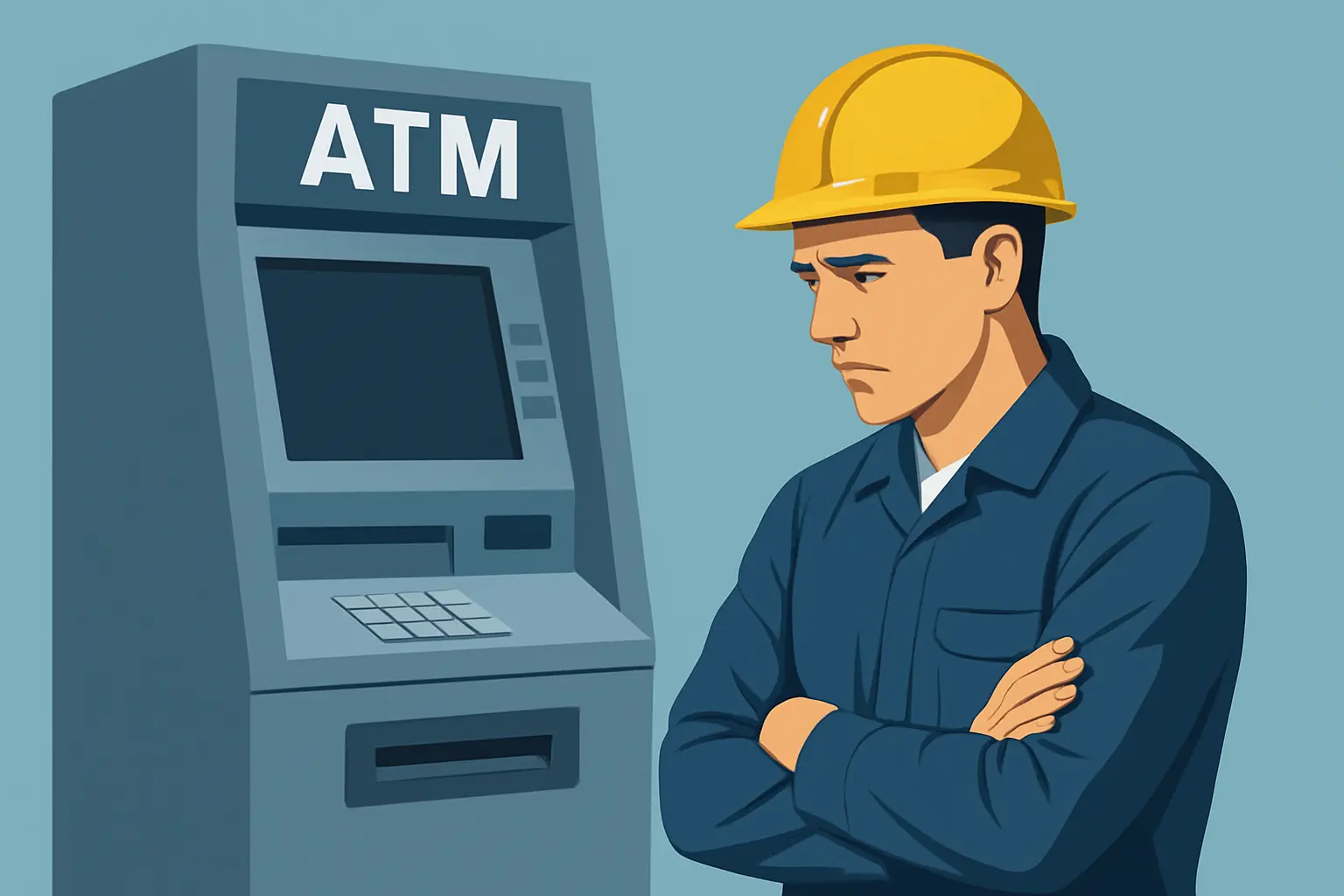
When We Can’t Rely on “The ATM Effect” and Technology Stops Creating Jobs, Human Labor Becomes Obsolete
If automation and AI stop producing “replacement jobs,” what happens to workers, wages, and the economy? This guide explains the ATM effect, why it has historically protected employment, what changes when it breaks down, and what practical policies and personal strategies can help in a world where human labor becomes obsolete in more and more sectors.
Quick takeaway: The “ATM effect” suggests technology often changes jobs rather than destroys them—freeing humans to do higher-value tasks. But with modern AI automation, there’s a realistic scenario where technology reduces labor demand faster than new jobs appear, creating a period (or era) of structural unemployment and lower wages for many workers.
Table of Contents
- What Is the “ATM Effect”? (Simple Definition)
- Why the ATM Effect Worked for Decades
- Why the ATM Effect Might Fail Now
- When Technology Stops Creating Jobs: What “Labor Obsolescence” Means
- Real-World Examples: Where Jobs Are Shrinking Without New Roles
- What Happens to the Economy If Human Labor Becomes Obsolete?
- Who Is Most at Risk? (Jobs, Skills, and Industries)
- Edge Cases and Limits: Why Humans Won’t Disappear From Work Overnight
- Practical Solutions: What Governments, Companies, and Individuals Can Do
- FAQ: Automation, AI, and the Future of Work
- Conclusion: The Post-ATM-Effect Era
What Is the “ATM Effect”? (Simple Definition)
The ATM effect is a popular example used in economics and “future of work” discussions:
- ATMs automated cash withdrawals, reducing the need for some teller tasks.
- But bank tellers didn’t disappear. Instead, their role shifted toward sales, customer service, and relationship banking.
- Meanwhile, ATMs reduced the cost of opening branches, so banks expanded locations—creating demand for staff.
In short: automation replaces tasks, not jobs—and can even expand employment through lower costs and new services.
Related search terms: ATM effect explained, automation creates jobs, technology and employment, tasks vs jobs.
Why the ATM Effect Worked for Decades
Historically, technology often boosted employment overall because it:
1) Lowered costs and increased demand
When production becomes cheaper, prices can fall and demand can rise. Higher demand can increase total work—even if each unit needs fewer labor hours.
2) Created new industries and occupations
Past waves of innovation created entire categories of work:
- IT support, software development, cybersecurity
- Digital marketing, e-commerce operations
- App ecosystems, cloud services, data analytics
3) Required humans to “wrap” the technology
New tools often increased the need for:
- Training, oversight, compliance
- Customer success, installation, sales
- Maintenance, operations, quality assurance
4) Spread slowly enough for adaptation
Many workers had time to re-skill, retire, or shift roles while the economy generated new opportunities.
Why the ATM Effect Might Fail Now
The concern behind the title—“technology stops creating jobs”—is not that innovation ends, but that modern automation may reduce labor demand faster than the economy can create new human roles.
Here are the main reasons:
1) AI replaces cognitive tasks, not just routine physical tasks
Earlier automation targeted repetitive work. Modern AI can now perform tasks that were “safe” because they required:
- Writing, summarizing, translating
- Basic legal drafting, document review
- Coding assistance and debugging
- Customer support and sales outreach
- Scheduling, payroll, reporting
This expands automation into white-collar and service jobs, not just factory floors.
2) A single tool can replace work across many industries
ATMs were specific to banking. By contrast, AI systems can be applied across sectors with minimal customization:
- HR, finance, marketing, operations
- Education content creation
- Healthcare admin and documentation
That broad reach increases the risk of simultaneous job displacement.
3) The “new jobs” may be too few and too specialized
Yes, AI creates new work (AI safety, model evaluation, prompt engineering, data governance). But these roles may:
- Employ fewer people than the jobs displaced
- Require high-level skills not easily acquired quickly
- Concentrate in specific cities/companies
4) Winner-take-most economics and extreme scaling
Digital products scale cheaply. A small team can serve millions. If AI makes teams even smaller, the number of jobs created per dollar of revenue can fall sharply—leading to jobless growth.
5) Businesses automate to compete, not to expand employment
When markets are saturated, productivity gains may not translate to more output—just fewer workers per unit of output.
When Technology Stops Creating Jobs: What “Labor Obsolescence” Means
“Human labor becomes obsolete” doesn’t necessarily mean nobody works. It usually means:
- For many tasks, humans are no longer cost-effective
- Wages face downward pressure because machines are cheaper and “good enough”
- Employment becomes polarized: a smaller group of high-paid roles, with fewer stable mid-level jobs
A practical definition
Human labor is “obsolete” in a domain when:
- Automation matches or exceeds human performance for typical work,
- Costs less, and
- Is reliable and scalable enough to run the business.
When those three conditions hold, companies are strongly incentivized to automate.
Real-World Examples: Where Jobs Are Shrinking Without New Roles
These examples show how displacement can outpace job creation:
1) Customer service and call centers
- Chatbots and AI agents can handle many tier-1 issues.
- Companies may keep a smaller number of humans for escalations.
- Net effect: fewer entry-level support jobs.
Keywords: AI customer service jobs, call center automation, chatbot replaces jobs.
2) Content production and marketing operations
- AI can draft ads, blogs, product descriptions, emails, and social posts.
- Human work shifts to strategy and editing—but many organizations need fewer writers overall.
3) Back-office administration
- Invoice processing, data entry, scheduling, payroll, reporting—prime targets for automation.
- These roles are widespread and historically provided stable employment.
4) Basic software development and QA tasks
- AI coding tools increase output per developer.
- Companies may hire fewer junior developers or reduce contract work.
Important nuance: Not every role disappears—many are compressed. One person + AI can do what a team used to do.
What Happens to the Economy If Human Labor Becomes Obsolete?
If labor demand drops broadly, the impacts can be structural.
1) Structural unemployment and underemployment
Workers can’t easily “move” to new jobs if:
- new roles are too few,
- require different skills,
- or are geographically concentrated.
2) Falling bargaining power and wage compression
When automated alternatives exist, employers can offer lower wages—especially for commoditized tasks.
3) Rising inequality
Ownership matters. If capital (companies, shareholders, IP holders) captures most productivity gains, wealth concentrates.
4) A demand problem: who buys the output?
This is a key edge case people often miss:
- Automation can increase supply (more goods/services).
- But if many people lose wages, consumer demand can fall.
- That can create a feedback loop where businesses don’t expand output—limiting job creation further.
5) Shifts in how people access income
If wages are no longer the main channel for distributing purchasing power, societies may need:
- stronger transfers,
- new ownership models,
- or new definitions of “work.”
Who Is Most at Risk? (Jobs, Skills, and Industries)
Risk is more about tasks than job titles, but some patterns are clear.
Higher risk
- Routine information work: data entry, basic reporting, scheduling
- Scripted communication: tier-1 support, telemarketing
- Standardized content: simple articles, product copy, basic design variants
- Predictable compliance/document work: templates, contract review (basic), form processing
Medium risk
- Roles with complex human interaction but lots of documentation: healthcare admin, HR operations
- Technical jobs with repeatable patterns: some QA/testing, junior coding tasks
Lower risk (for now)
- Work requiring physical presence in messy environments: many trades, field repair
- High-stakes accountability: certain medical decisions, legal responsibility
- Deep relationship work: enterprise sales, negotiation, leadership
- Hands-on care: childcare, eldercare (though admin parts can still be automated)
Edge Cases and Limits: Why Humans Won’t Disappear From Work Overnight
Even if the ATM effect weakens, there are real constraints.
1) Trust, liability, and regulation
Organizations may be legally required to keep humans “in the loop,” especially in finance, healthcare, and safety-critical systems.
2) Data and integration problems
Many companies can’t automate fully because their systems are fragmented, messy, or insecure. Implementation takes time.
3) The “last mile” is hard
Automation excels at typical cases. Edge cases, exceptions, and ambiguous situations still often require humans.
4) Human preference and premium markets
Some customers will pay for human service—like human financial advising, bespoke design, or concierge support—even if automated options exist.
Practical Solutions: What Governments, Companies, and Individuals Can Do
If technology stops creating enough jobs, the solution is not “stop technology.” It’s adaptation of institutions: income distribution, education, ownership, and labor policy.
For governments: stabilizers and new income channels
- Wage insurance for displaced workers (temporary supplements)
- Expanded unemployment support tied to retraining
- Portable benefits for gig/contract work
- Universal Basic Income (UBI) or negative income tax (various designs)
- Public investment in care, infrastructure, climate resilience (hard to automate fully and socially valuable)
- Tax policy updates to handle capital-heavy production (design matters to avoid killing innovation)
Common searches: UBI and automation, policies for AI unemployment, job displacement solutions.
For companies: responsible automation strategy
- Use AI to augment employees where possible rather than immediate replacement
- Offer reskilling (real pathways, not just videos)
- Build “human oversight” roles: QA, audits, safety checks, customer escalation
- Measure success not only by cost reduction, but by retention, service quality, risk reduction
For individuals: practical career moves (beginner-friendly)
- Aim for “AI-proof” task mixes, not mythical AI-proof jobs
Look for roles combining human trust + context + responsibility. - Learn to supervise AI
Skills like reviewing outputs, setting constraints, and validating accuracy are valuable in many fields. - Build domain expertise
AI is strongest as a general tool. Humans with deep industry knowledge can direct it effectively. - Strengthen human skills that scale with technology
- Communication, negotiation, customer empathy
- Project ownership, decision-making
- Cross-functional collaboration
- Create optionality
Side income, certifications, networking, and geographic flexibility reduce risk.
FAQ: Automation, AI, and the Future of Work
Will AI take all jobs?
Not all jobs—but it can take many tasks inside most jobs. The risk is a net reduction in total labor demand if new roles don’t appear fast enough.
Didn’t technology always create more jobs historically?
Often yes, through new industries and demand expansion. The worry is that modern AI may be different due to speed, broad applicability, and extreme scalability, weakening the “ATM effect.”
What’s the most likely scenario?
More likely than “everyone unemployed” is a long period of:
- job churn,
- fewer entry-level roles,
- wage pressure in mid-skill jobs,
- and growth concentrated among firms that own AI and data.
What should I learn to stay employable?
Combine basic AI fluency (using tools, verifying outputs) with domain expertise (healthcare, finance, logistics, education, trades) and human-facing skills.
Conclusion: The Post-ATM-Effect Era
The ATM effect taught us an optimistic lesson: automation can eliminate tasks while creating new work. But if AI automation scales across industries and compresses teams faster than new human roles emerge, we may enter a world where human labor becomes obsolete for large categories of work.
The realistic challenge is not science fiction—it’s distribution:
- Who earns income when wages aren’t central?
- Who owns the productive technology?
- How do we preserve dignity, stability, and opportunity?
If societies update policies, companies adopt responsible deployment, and workers build skills that complement machines, we can capture the productivity benefits of AI without turning job displacement into a permanent crisis.
Related Topics (for further reading)
- Automation vs AI: what’s the difference?
- Jobless growth and productivity paradox
- Universal Basic Income (UBI) and the future of work
- Reskilling programs that actually work
- Human-in-the-loop systems and AI governance
Tip for readers: If you found this useful, search: “ATM effect automation jobs”, “AI job displacement by industry”, and “policies for automation unemployment” to compare perspectives and data.
Worth sharing?
Send this to someone who would find it useful.