What programming language to start learning in 2026?
Published
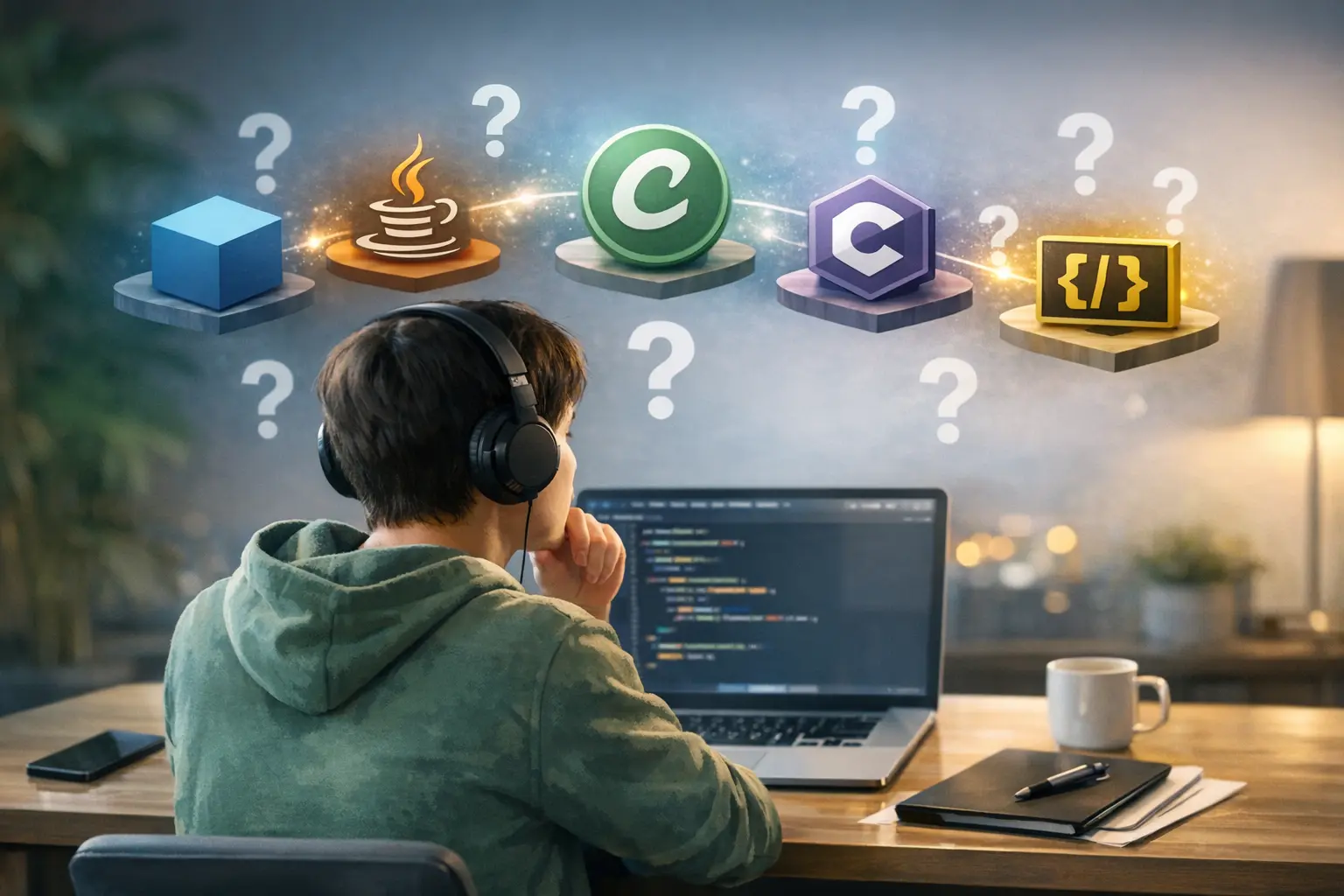
What Programming Language to Start Learning in 2026?
Every year someone declares a “best programming language,” and every year that answer is only half true. The honest answer depends on what you want to build, how fast you want to get hired, and what kind of work you can see yourself doing when the honeymoon phase of learning wears off.
Still, if you’re searching “what programming language should I learn in 2026,” you’re probably looking for a practical recommendation you can act on today. You want something that won’t be obsolete in 18 months, that has real job demand, and that won’t feel like you’re trying to learn to drive in a Formula 1 car.
So here’s the most real-world, 2026-proof guidance I can give:
If you want the single best first programming language for most beginners in 2026, learn Python.
If you want the best language to start learning for a job in web development, learn JavaScript (and then TypeScript).
If you want to build mobile apps, learn Swift for iOS or Kotlin for Android.
If you want to do systems programming, game engines, high-performance tools, or you’re serious about computer science fundamentals, learn Rust (or C++ if you have a specific reason).
And if you want to maximize your odds in enterprise jobs, learn Java or C#.
That’s the map. Now let’s make it personal and concrete, with examples, tradeoffs, and the fastest path from “I’m new” to “I can actually build things.”
The best programming language to start with in 2026 (for most people): Python
Python keeps winning as a beginner programming language because it’s the best combination of readable syntax, huge ecosystem, and real-world usefulness. It’s not just “easy.” It’s forgiving, it’s everywhere, and it lets you focus on the core skill that matters: learning to think like a programmer.
In 2026, Python continues to be the most pragmatic starting point if any of these are true:
You want to get into AI, machine learning, data science, automation, scripting, or backend development. You want to build small tools fast. You want immediate wins that motivate you to keep going.
Python also has an unusually strong learning pathway. You can start with basic scripts, then build web apps with frameworks like Django or FastAPI, then move into analytics with Pandas, or into AI workflows with PyTorch and common LLM tooling.
A lot of beginners ask: “But is Python too slow?” For learning and for most real products, it’s not a deal-breaker. Performance bottlenecks are usually in your database queries, your architecture, or your algorithms, not the language. And when performance truly matters, Python integrates well with faster components.
If your goal is to start learning programming in 2026 and you don’t have a strong specialization yet, Python gives you the widest runway.
The best language to learn for web development in 2026: JavaScript (then TypeScript)
If your goal is to build websites and web apps, JavaScript is not optional. It’s the native language of the web, and that’s a massive advantage for beginners because it reduces friction. You can write code, refresh the browser, and see results immediately. That fast feedback loop is one of the best teachers.
In 2026, learning JavaScript is still the most direct path into:
Front-end development (React is still dominant, and alternatives like Vue and Svelte continue to be strong). Full-stack development via Node.js. Real jobs at startups and large companies.
But here’s the real pro move: treat JavaScript as your gateway and then learn TypeScript as soon as you’re comfortable. TypeScript adds types and structure, which makes larger projects easier to maintain and makes you more employable. A lot of modern teams now default to TypeScript, especially for production web apps.
If you’re thinking “should I learn JavaScript or Python first,” the practical answer is:
Choose JavaScript if you want to build web apps and user interfaces. Choose Python if you’re leaning toward data, AI, automation, or general-purpose coding with fewer moving parts at the beginning.
Both are valid. JavaScript just happens to be unavoidable in web.
The best programming language for AI in 2026: Python (with a reality check)
Let’s be blunt: if your motivation is AI, “learn Python” is still the correct answer in 2026.
The AI and machine learning ecosystem is Python-first. Most tutorials, libraries, research code, and production tooling still assumes Python. That’s not because Python is the most elegant language. It’s because it’s the language the ecosystem built around, and ecosystems are sticky.
But here’s the reality check that will save you months: learning an AI library is not the same as learning programming.
If you’re starting from zero, spend your first weeks building basic Python skills, then learn the fundamentals that actually power AI work: data structures, probability intuition, evaluation metrics, and how to handle data. In AI projects, the hard part often isn’t the model. It’s cleaning data, designing experiments, debugging pipelines, and making systems reliable.
Python gets you in the door. Your discipline and fundamentals keep you there.
The best language to start for mobile app development in 2026: Swift or Kotlin
If your dream is to publish apps, don’t overcomplicate it.
For iPhone and iPad app development, start with Swift. Swift is mature, fast, and the default for Apple platforms. The tooling is opinionated, but once you’re inside it, you can ship real apps with a clean developer experience.
For Android development, start with Kotlin. Kotlin is modern, expressive, and the primary language for Android. It’s also a good general-purpose language that feels far less dated than legacy Java codebases.
You’ll hear about cross-platform options like Flutter (Dart) and React Native (JavaScript/TypeScript). They’re real, and they can be great if you want one codebase for iOS and Android. But if you’re a true beginner and you want the clearest path to competence and a portfolio that hiring managers trust, native is still the straight line: Swift for iOS, Kotlin for Android.
The best language for game development and high performance in 2026: C# or Rust (depending on your path)
Game development is one of those areas where the “best first language” depends on your engine and your goals.
If you want to build games and actually ship something without getting swallowed by low-level complexity, C# is a fantastic starting language in 2026, largely because of Unity and the broader .NET ecosystem. C# also translates well into non-game jobs: backend services, desktop apps, enterprise development.
If you’re drawn to performance, engine programming, compilers, or you want to learn a language with modern safety guarantees, Rust is an excellent choice. Rust is not the easiest first language, but it teaches you how memory and performance really work, and it’s increasingly used in systems-level tooling.
C++ remains heavily used in AAA game development and performance-critical code, but as a first language it has a steeper learning curve and more footguns. Learn it if you have a specific reason, like a target studio, a university track, or an engine codebase you want to contribute to.
The best programming language for getting hired fast in 2026: it depends on the market, but the pattern is clear
People ask “what programming language has the most jobs in 2026.” Job boards shift by region, but the demand clusters are consistent.
Web roles are still massive, and that points to JavaScript and TypeScript. Data and AI roles keep growing, and that points to Python. Enterprise and backend jobs remain huge, and that points to Java, C#, and increasingly Go in cloud-native environments.
If you’re optimizing for employability as a beginner, don’t only think in terms of the language. Think in terms of the kind of portfolio you can build with that language.
A hiring manager is not hiring “a Python developer.” They’re hiring someone who can ship a web API, write tests, debug a production issue, or build a dashboard that stakeholders actually use. Languages are the entry ticket. Projects are the proof.
If you only want one answer: learn Python, then add JavaScript
If you’re stuck in decision paralysis, here’s the simplest plan that works for most beginners in 2026:
Start with Python for fundamentals, problem solving, and quick wins. Then learn JavaScript so you can build web interfaces and understand the internet’s default language.
That combination makes you dangerous in a good way. You can automate tasks, analyze data, build APIs, and create real web apps people can use. It also gives you flexibility: you can pivot to AI, backend, or full-stack without starting over.
You’ll see debates about “Python vs JavaScript” and “best first programming language.” In practice, you’ll likely learn more than one language anyway. The trick is choosing the one that keeps you motivated long enough to become competent.
What about “new” languages in 2026? Go, Rust, and TypeScript are the ones to watch
If you’re reading trendy lists, you’ll see a lot of noise. Ignore most of it.
The modern languages that have earned their place, and are especially worth considering in 2026, are:
TypeScript, because it’s now the professional default for serious JavaScript codebases.
Go, because it’s straightforward, fast to learn, and strong in cloud infrastructure, backend services, and DevOps. If your goal is backend in a cloud-native world, Go is one of the most practical choices.
Rust, because it’s becoming a long-term systems language with real momentum in tooling and infrastructure, and it teaches deep skills. It’s not always the fastest route for a beginner, but it’s a strong investment for the right personality.
You don’t need to chase novelty. You need a language that has a healthy ecosystem, good learning resources, and real jobs.
How to choose the right first programming language in 2026 (without overthinking)
Ask yourself one question: “What do I want to build in the next 30 days?”
If the answer is “something that runs on my computer and helps me,” Python is ideal.
If the answer is “a website or a web app I can show friends,” JavaScript is ideal.
If the answer is “an iPhone app,” Swift.
If the answer is “an Android app,” Kotlin.
If the answer is “I want a stable corporate developer job,” Java or C#.
If the answer is “I care about performance and fundamentals,” Rust.
The best programming language to start learning is the one that lets you ship a small project soon. Motivation is a resource, and beginners waste it when they spend months preparing to begin.
A practical 2026 learning path that actually works
Start simple and build momentum. In week one, you should already be writing code daily. In month one, you should have a tiny project you can show. In month three, you should have something with users, even if the only user is you.
Pick Python or JavaScript. Learn basic syntax and control flow. Learn functions. Learn how to read error messages. Learn how to use Git early, because real development includes version control.
Then build something small but complete: a personal expense tracker, a simple habit app, a web scraper that emails you results, a tiny API, a portfolio site, a basic chat app. The project matters more than the perfection of your language choice.
Final recommendation: what programming language should you start learning in 2026?
For most beginners in 2026, the best programming language to start learning is Python, because it’s beginner-friendly, widely used, and the fastest route into automation, backend development, data science, and AI.
If your goal is web development, start with JavaScript and move to TypeScript.
If your goal is mobile, learn Swift (iOS) or Kotlin (Android).
If your goal is enterprise backend, choose Java or C#.
If your goal is systems and performance, choose Rust.
The secret is that you’re not marrying the language. You’re choosing your first vehicle. Pick the one that gets you moving, then keep driving until you can build things that make people’s lives easier. That’s what turns “learning to code” into a career.
Worth sharing?
Send this to someone who would find it useful.