Top Tourist Destinations in Korea for Culture and History
Published
Top Tourist Destinations in Korea for Culture and History: A Guide Worth Keeping
Most people who visit South Korea spend three days in Seoul, hit Gyeongbokgung Palace, eat their weight in bibimbap, and fly home feeling like they’ve seen the country. They haven’t. Korea’s cultural and historical landscape is layered across a peninsula that has been continuously inhabited, fought over, rebuilt, and reimagined for more than five thousand years, and scratching the surface of Seoul tells you about as much as spending a weekend in Times Square tells you about America.
This guide is for people who want the fuller picture. Whether you’re planning your first trip or your third, you’ll come away knowing which sites genuinely repay time and attention, why certain places carry historical weight that no guidebook caption can fully convey, and where to find the Korea that most tourists miss entirely. I’ve spent time in each of these destinations, made the rookie mistake of underestimating Gyeongju (more on that later), and read enough Korean history to understand what I was actually looking at. That context changes everything.
Gyeongju: The City That Is Itself a Museum
Gyeongju isn’t a destination with a museum. It is one. The old capital of the Silla Kingdom, which unified most of the Korean peninsula in 668 CE and lasted nearly a thousand years, Gyeongju was designated a UNESCO World Heritage Site in 2000, and archaeologists estimate that perhaps a third of the city sits atop unmapped Silla-era tombs.
The most immediately striking feature is the tumuli, the great grassy burial mounds that rise out of the city center like green hills that somehow ended up inside a town. The largest cluster, Daereungwon Tomb Complex, contains 23 royal tombs, and you can walk through a park where children are flying kites forty feet from burial chambers that held silk, gold, and jade when they were sealed in the fifth century. One of those tombs, Cheonmachong, is open to visitors and contains a replica of the “Heavenly Horse” painting discovered inside, one of the few examples of Silla painting to survive.
A short drive outside the city center sits Bulguksa Temple, built in 774 CE under the Unified Silla dynasty. The stone staircases leading to the main hall represent the path from the earthly world to the Buddhist paradise, a symbolic architectural detail that almost every visitor walks past without knowing it. The nearby Seokguram Grotto, a granite rotunda housing a seated Buddha carved in the eighth century, is considered one of the finest examples of Buddhist art in East Asia.
My mistake on my first visit was treating Gyeongju like a half-day stop between Busan and Seoul. I rushed through Bulguksa in ninety minutes and barely touched the tumuli. The city deserves at least three days. The Gyeongju National Museum alone, which houses over 30,000 Silla artifacts, needs a dedicated afternoon.
Pro tip: Visit Anapji Pond at dusk. The man-made lake was built by King Munmu in 674 CE as a pleasure garden, and it’s lit beautifully after dark. The reflection of the reconstructed pavilions on the water is one of those images that doesn’t survive being rushed.
Seoul’s Palaces: More Than Royal Stage Sets
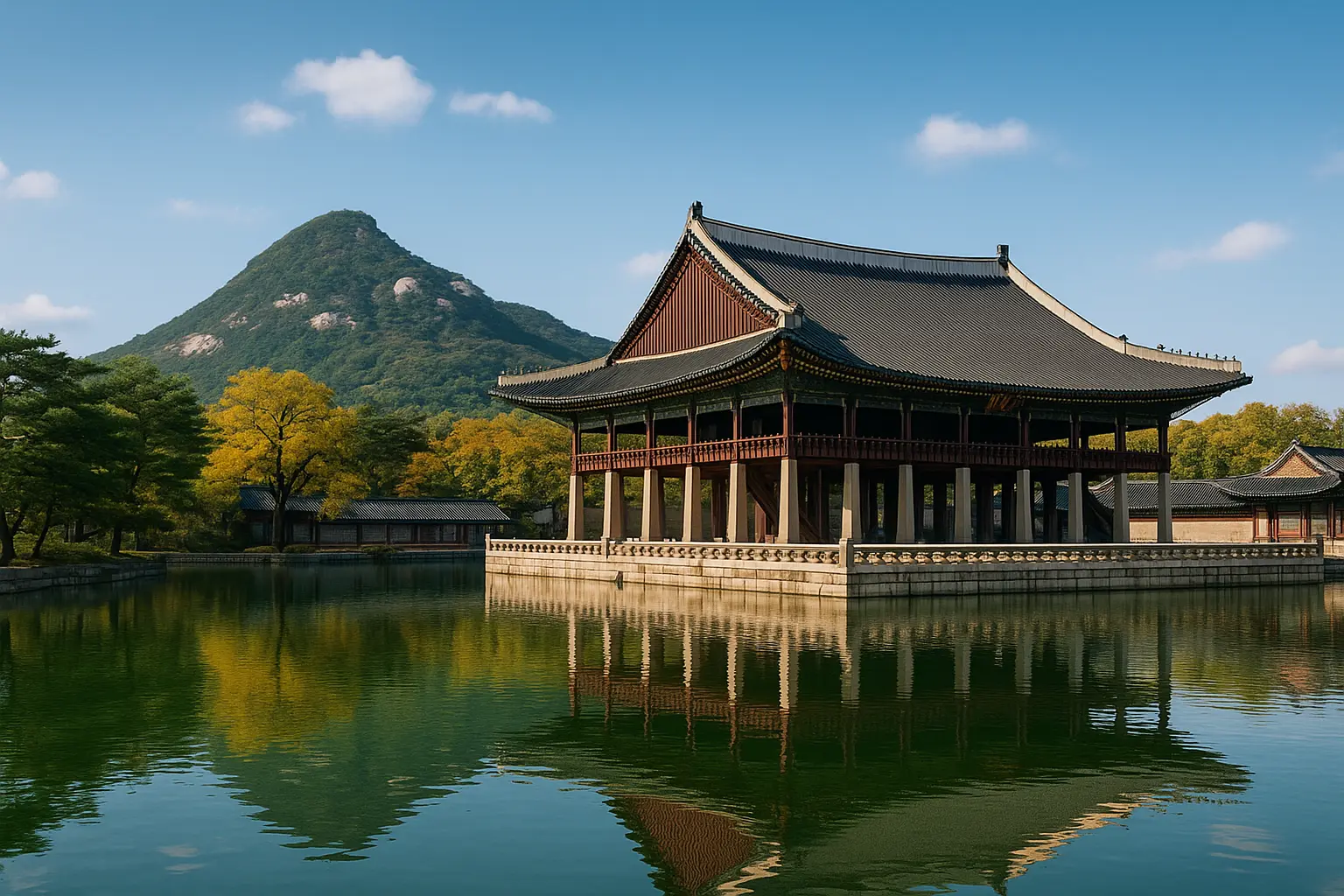
Seoul has five grand Joseon-era palaces, a fact most tourists don’t know and therefore most tourists see only one. Gyeongbokgung, the largest and most photographed, draws around three million visitors a year, and on a weekend it can feel more like a costume rental queue than a historical site. It is genuinely impressive, but it rewards knowing what you’re looking at.
The palace was deliberately destroyed by Japan. During the colonial period (1910-1945), the Japanese colonial government demolished roughly 90% of Gyeongbokgung’s buildings and constructed the imposing Japanese Government-General building directly in front of the Gwanghwamun Gate, blocking the palace’s axis and, symbolically, suppressing the Korean royal line’s sight line to the mountains. That building wasn’t demolished until 1995. The restoration of the palace complex has been ongoing since the 1990s and remains incomplete, which means the grounds have an honest, work-in-progress quality if you know to look for it.
The palace most visitors skip, Changdeokgung, is arguably more interesting. Also a UNESCO World Heritage Site (1997), it’s the best-preserved of the five palaces, and its Huwon (Secret Garden), a 78-acre wooded garden of pavilions, ponds, and ancient trees, is only accessible by guided tour with limited daily capacity. The garden functioned as a private retreat for the royal family from the 17th century onward, and the 300-year-old trees that shade its walking paths have a quiet authority that the busier Gyeongbokgung simply can’t offer. Book tickets ahead; they sell out.
For a counterintuitive visit, spend time at Deoksugung Palace. It’s small, surrounded by modern office towers in the heart of Seoul’s business district, and it’s the only palace where European-style stone buildings sit alongside traditional Korean architecture. That jarring combination isn’t an accident. It reflects Korea’s tumultuous late-19th-century negotiations with modernity, the period when Joseon became the Korean Empire and desperately tried to modernize before Japanese annexation ended that experiment. The palace grounds tell you more about 1900s Korea than most textbooks do.
Jeonju: Where Joseon Korea Still Lives
Jeonju is most famous outside Korea for food (it’s the originating city of bibimbap and arguably the culinary capital of the country), but its Hanok Village offers something rarer than a good meal: genuine continuity with the past.
Jeonju Hanok Village contains roughly 735 traditional Korean houses, the largest surviving concentration in the country. These aren’t reconstructed. They were built here, stayed here, and people live in them. The curved tile rooftops and wooden latticed doors of a hanok (traditional Korean house) are designed around a philosophy of harmony with the surrounding landscape, built low, open to courtyards, using materials that breathe with seasonal changes. Walking through Jeonju’s lanes, you get a sense of what a Korean city looked and felt like before concrete arrived.
The village is also home to Jeondong Catholic Cathedral, built in 1914, which stands at the site where Korean Catholics were executed during 19th-century persecutions. The cathedral is built partly from the bricks of the prison where those martyrs were held. That detail is inscribed on a plaque that most visitors walk past. It’s worth stopping for.
One honest note: parts of Hanok Village have become heavily commercialized, with souvenir shops selling things no one’s ancestors ever owned. The key is to walk past the main strip and into the quieter residential lanes behind it, where the commercial layer drops away and the architecture speaks for itself.
The DMZ: History You Can Stand Inside
The Demilitarized Zone, a 160-mile-long, 2.5-mile-wide strip of land separating North and South Korea, is the most heavily armed border on earth. It is also, paradoxically, one of the most biodiverse zones in the peninsula, since no humans have disturbed it since 1953. Endangered species including the Amur leopard cat and white-naped crane live there.
Visiting the DMZ from Seoul (about an hour north by tour bus) is not a military tourism gimmick. It is a chance to understand something about modern Korean history that no other experience can fully convey: that the Korean War never technically ended. The 1953 armistice was a ceasefire, not a peace treaty, and the families separated by the division have now lived apart for more than 70 years. At the Joint Security Area in Panmunjom, you can stand in the blue conference room that straddles the military demarcation line, technically placing one foot in North Korea. The weight of that moment, standing in a room where negotiations that never quite succeeded have been going on for decades, is hard to describe.
The Third Infiltration Tunnel, discovered in 1978, shows what was intended to be a North Korean invasion route dug under the border. It is 1.7 meters tall, reinforced with concrete, and large enough to move 30,000 soldiers per hour. You can walk part of it.
The counter-intuitive truth about the DMZ is that its bluntness is the point. You are not being shielded from the reality here. The conflict is present tense, not past tense, and the experience makes that viscerally clear in a way that sitting at home reading about it never could.
Busan’s Layered History: War Cemeteries and Colorful Hillsides
Busan is Korea’s second city and its busiest port, and it carries a specific historical identity that most visitors overlook in their rush to its famous beaches and fish markets. During the Korean War, Busan was the last holdout, the “Pusan Perimeter,” the narrow rectangle of land that UN forces and the South Korean army held while North Korean forces controlled nearly all of the peninsula. From August to September 1950, the fate of South Korea was decided within those shrinking lines.
The UN Memorial Cemetery in Busan is the only UN cemetery in the world. It holds the remains of 2,300 soldiers from 11 countries who died during the Korean War. The grounds are immaculate, solemn, and almost always quiet. Sections are organized by nationality, Australia, Canada, the United Kingdom, Turkey, and others, and the contrast between visiting this site and then walking to the vivid, chaotic Jagalchi fish market ten minutes away captures something true about Busan: life and grief occupy the same geography without resolving into each other.
Gamcheon Culture Village, a hillside neighborhood of brightly painted houses that tumbles down toward the sea, began as a settlement for refugees during the Korean War and has since been transformed by a community art project starting around 2009. It’s Instagram-famous now, which means it can be crowded, but the history underneath the colorful facades is worth knowing. The people who first lived here had nothing and built everything they could out of the hillside, and the layered, dense, staircase-connected neighborhood reflects that improvised urgency.
Planning Your Visit: What to Actually Do With This Information
Before booking anything, decide what kind of traveler you are. Gyeongju and Jeonju reward slow, unhurried time. The DMZ requires a pre-booked organized tour (most operators depart from central Seoul; Koridoor and JSA Tours are two reputable options). The Seoul palaces are easy to combine into a multi-day city itinerary, and Changdeokgung’s Secret Garden sells out, so book that ticket before you even book your flight.
If your window is short, prioritize by era: Gyeongju for ancient Korea (Silla period, roughly 57 BCE to 935 CE), Jeonju for the Joseon dynasty (1392-1897), Seoul’s palaces for the transition into the modern era, and the DMZ for the unresolved 20th century. That sequence gives you a rough chronological arc through roughly 2,000 years.
For deeper reading before you go, Bruce Cumings’ “Korea’s Place in the Sun” is the most readable serious history of the peninsula in English. It’s frank about the complexity of the colonial period and the war in ways that popular travel writing rarely is. Reading even the first few chapters before visiting the DMZ or the UN Cemetery will double the meaning of what you see there.
Where This Is All Heading
Korean cultural tourism is growing fast, driven significantly by the global reach of Korean pop culture, which is bringing younger international visitors who then discover that there’s a Korea that predates K-pop by several millennia and find it equally compelling. The Korean government invested $497 million in cultural tourism infrastructure between 2020 and 2023, with significant funds going toward digital interpretation tools at historical sites, audio guides, and AR overlays at places like Gyeongbokgung.
The question worth sitting with, especially if you visit the DMZ: Korea is the only divided nation still waiting for reunification. Every historical site on this list exists in the shadow of that unresolved fact. The ancient kingdoms, the Joseon palaces, the colonial trauma, the war, and the division are not separate chapters. They are one continuous story that is still being written.
Go to Korea curious, not just entertained. The sites will give you more than you expect.