The Psychology of Spending: Why Smart People Make Dumb Financial Decisions
Published
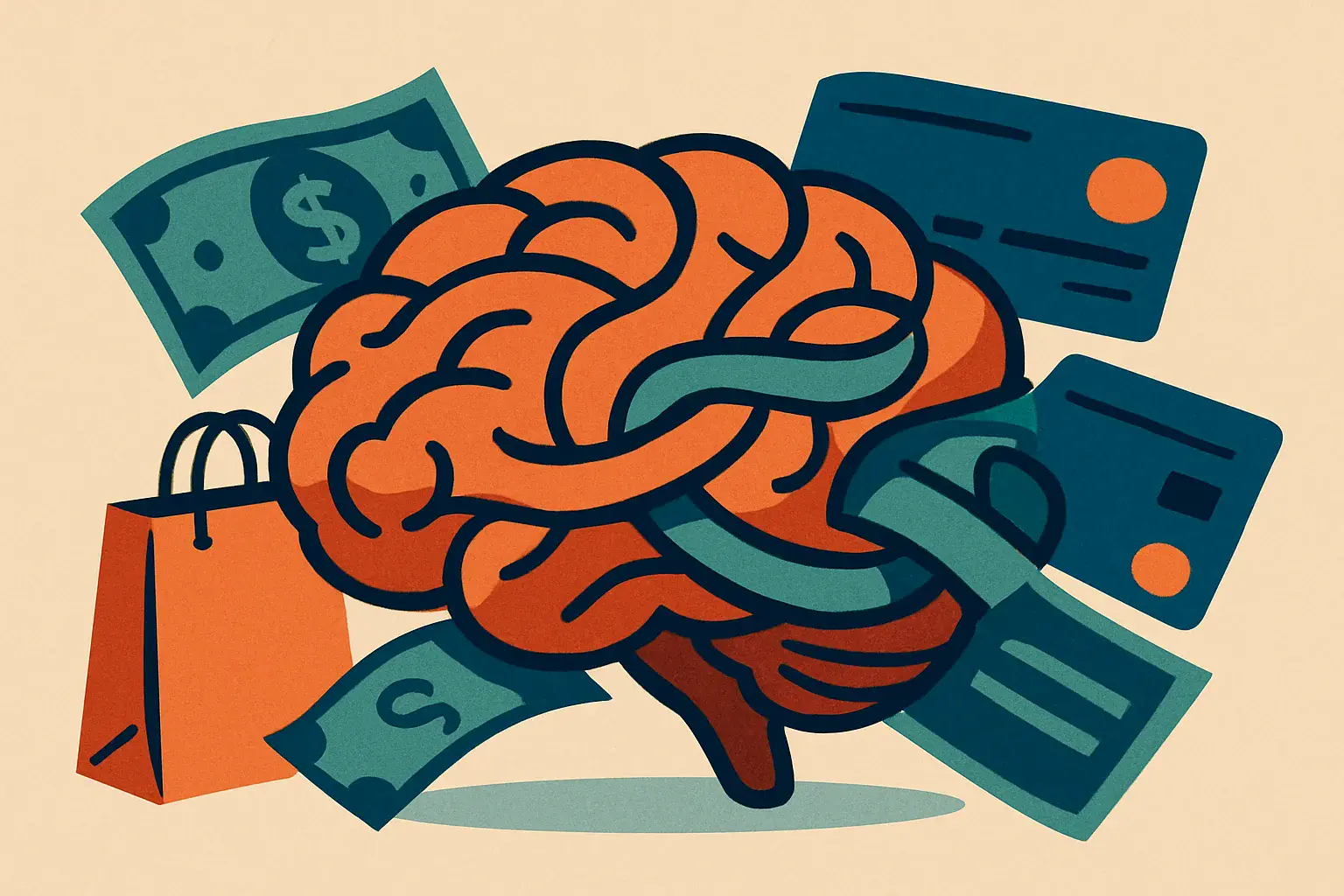
The Psychology of Spending: Why Smart People Make Dumb Financial Decisions
You can be brilliant at your job, well-read, analytically sharp, and still make financial decisions that a dispassionate observer would call absurd. Buying a car you can’t afford because the monthly payment “felt manageable.” Subscribing to seven streaming services you barely use because canceling each one feels like losing something. Spending more at a restaurant because someone else at the table ordered an expensive bottle of wine.
This isn’t stupidity. It’s psychology.
The way humans process financial decisions is riddled with cognitive shortcuts, emotional triggers, and social pressures that have nothing to do with intelligence. The same brain that can solve differential equations or negotiate a million-dollar contract will consistently overpay for convenience, undervalue future money, and rationalize purchases that serve no practical purpose.
Understanding why this happens is the first step toward spending in a way that actually reflects your values and goals. Not through willpower or guilt, but through awareness of the mental patterns that quietly drain your bank account.
Your brain was not designed for modern financial decisions
Human cognition evolved to handle immediate, concrete threats and rewards. A piece of fruit in front of you versus a harvest that might come in three months. A predator nearby versus a theoretical risk next season. Our ancestors survived by prioritizing the present, and that wiring hasn’t changed much.
Modern financial life asks the opposite. It asks you to delay gratification for decades, to compare abstract numbers across time, to resist emotional impulses in environments specifically designed to trigger them. Every time you walk into a store, open an app, or scroll past an ad, you’re fighting millions of years of evolutionary programming with a prefrontal cortex that gets tired after lunch.
This mismatch between how our brains work and what modern finances demand explains most of the “irrational” spending behavior that economists love to study and ordinary people love to regret.
The cognitive biases that quietly empty your wallet
Behavioral economists have catalogued dozens of biases that distort financial decisions. You don’t need to memorize them all. But understanding the big ones can save you thousands of dollars a year, because once you see these patterns, you can’t unsee them.
Anchoring: the first number wins
Anchoring is the tendency to rely too heavily on the first piece of information you encounter. In spending, this plays out constantly.
A jacket “marked down” from $300 to $180 feels like a bargain. But the $300 was never the real price. It was the anchor, set deliberately so that $180 would feel reasonable. Without the anchor, you might have looked at a $180 jacket and walked away.
Car dealerships are masters of anchoring. The sticker price is set high so that the “negotiated” price feels like a win, even if you’re still overpaying. Real estate listings work the same way. So do SaaS pricing pages with a deliberately expensive “enterprise” tier that makes the mid-tier look sensible.
The defense against anchoring is simple but hard: decide what something is worth to you before you see the asking price. If you walk into a negotiation or a store with your own number in mind, the anchor loses its power.
Loss aversion: losing hurts more than gaining feels good
Research by Daniel Kahneman and Amos Tversky famously demonstrated that people feel the pain of losing roughly twice as strongly as they feel the pleasure of an equivalent gain. Losing $100 hurts more than finding $100 feels good.
This asymmetry drives a huge amount of financial behavior. It’s why people hold losing investments too long, hoping to “get back to even” rather than cutting losses. It’s why subscription services are so profitable: canceling feels like losing access to something, even if you haven’t used it in months. It’s why “limited time offers” work. The fear of missing out on a deal triggers loss aversion more than the desire for the product itself.
Loss aversion also explains why people overpay for insurance, extended warranties, and protection plans. The fear of a potential loss outweighs a rational assessment of probability. A $200 warranty on a $400 appliance rarely makes mathematical sense, but it makes emotional sense because it eliminates the possibility of feeling that specific pain.
The sunk cost fallacy: throwing good money after bad
You’ve spent $80 on concert tickets. The night arrives and you’re exhausted, it’s raining, and you don’t particularly want to go anymore. But you go anyway, because “I already paid for it.”
That’s the sunk cost fallacy. The $80 is gone whether you attend or not. The rational question is: “Would I enjoy going tonight more than staying home?” But the brain insists on factoring in money that’s already spent and can’t be recovered.
This fallacy scales up dramatically. People stay in bad investments, bad business ventures, bad relationships, and bad career paths because they’ve already invested so much. Walking away feels like admitting the past investment was wasted. So they double down, which often makes the total loss larger.
The antidote is to regularly ask yourself: “If I were starting from scratch today, with no prior investment, would I choose this?” If the answer is no, the prior investment is irrelevant.
Mental accounting: money is money, except when it isn’t
Mental accounting is the tendency to treat money differently depending on where it came from or what mental “bucket” it lives in.
A tax refund feels like “bonus money” and gets spent more freely than the same amount earned through a paycheck. A $20 bill found in an old jacket feels like free money and gets wasted on something you’d never buy with “regular” money. Casino winnings feel different from salary, so people gamble more recklessly with their winnings.
In reality, money is fungible. A dollar is a dollar regardless of its source. But mental accounting means people will simultaneously carry credit card debt at 22% interest while keeping money in a savings account earning 4%, because the savings account is “for emergencies” and the credit card is “a separate thing.”
Recognizing mental accounting helps you make cleaner decisions: treat all your money as one pool, and allocate it based on the highest-impact use, not based on arbitrary categories your brain invented.
The environmental traps that make spending feel invisible
Beyond cognitive biases, the modern spending environment is engineered to reduce friction and increase impulse purchases. Smart people aren’t just fighting their own psychology. They’re fighting billion-dollar design teams.
The pain of paying has been anesthetized
Paying with cash activates the brain’s pain centers. Handing over physical bills creates a tangible sense of loss. Credit cards reduce that pain. Contactless payments reduce it further. One-click purchasing and auto-renewing subscriptions eliminate it almost entirely.
Research consistently shows that people spend more when using cards versus cash, more with contactless versus chip-and-pin, and more with stored payment methods versus manual entry. Each layer of abstraction between you and the act of paying makes the spending less “real” to your brain.
This is by design. Payment companies and retailers both benefit from reducing payment friction. The easier it is to pay, the more you pay.
A practical countermeasure: for discretionary spending categories where you tend to overspend, introduce friction deliberately. Use cash for dining out. Delete saved payment methods from shopping apps. Add a 24-hour rule before any non-essential purchase over a certain amount.
Subscription creep: the slow bleed
Subscriptions are the financial equivalent of a slow leak in your roof. Each one is small enough to ignore. Together, they add up to a significant monthly expense that most people dramatically underestimate.
The average person in the US spends substantially more on subscriptions than they think. Studies have consistently found a gap between what people estimate they spend on recurring charges and what they actually spend, often by 50% or more.
Subscriptions exploit a specific psychological weakness: the difference between active and passive decision-making. Signing up is an active choice you make once. Canceling is also an active choice, but one you have to make repeatedly, every month you don’t cancel. Inertia wins.
The fix is a quarterly subscription audit. Pull your bank and credit card statements, list every recurring charge, and ask one question about each: “If this canceled itself today, would I actively re-subscribe?” If not, cancel it now. Not tomorrow. Now.
Social spending: keeping up with a lifestyle you didn’t choose
Spending is social. What you buy, where you eat, where you live, and what you drive are all influenced by the people around you. This isn’t vanity. It’s deeply human. Social belonging is a survival instinct, and in modern life, consumption is one of the primary signals of group membership.
The problem is that social spending benchmarks are often set by the highest earner in your circle, or worse, by the curated highlight reels on social media. You end up calibrating your spending to a standard that doesn’t reflect your actual income, savings rate, or goals.
The most financially successful people I’ve observed share a common trait: they’re comfortable being visibly less extravagant than their peers. They drive older cars, live in modest homes relative to their income, and spend generously on things they genuinely value while being ruthlessly cheap on things they don’t.
That selective frugality is only possible if you’ve consciously decided what matters to you, independent of what your social group signals.
Why willpower alone doesn’t work
The standard advice for spending problems is to “be more disciplined” or “just stick to a budget.” This advice is correct in theory and useless in practice for most people, because it treats spending as a willpower problem when it’s actually a systems problem.
Willpower is a depletable resource. You have less of it when you’re tired, stressed, hungry, or emotionally drained. And those are exactly the moments when impulse spending is most likely to happen. Relying on willpower to override deeply wired psychological patterns is like relying on a bucket to bail out a flooding basement. It works for a while, but it doesn’t fix the leak.
Better approaches use systems to reduce the number of decisions your willpower needs to handle.
Automate savings and investments so the money moves before you see it. Use separate accounts for different purposes so spending limits are structural, not aspirational. Batch discretionary purchases into a weekly or monthly review so impulse buys have time to cool off. Set up intentional friction for categories where you overspend.
The goal isn’t to never spend money on things you enjoy. The goal is to make spending a conscious choice rather than a default behavior, so that when you do spend, it’s on things that actually matter to you.
Reframing spending as a reflection of values
Here’s where the psychology of spending gets interesting, and ultimately hopeful.
Once you understand the biases, the environmental traps, and the limitations of willpower, you can stop moralizing about spending and start treating it as a design problem. The question shifts from “Why am I so bad with money?” to “How do I build a system that aligns my spending with what I actually value?”
That reframe is powerful because it removes guilt and replaces it with curiosity. Instead of feeling bad about a purchase, you can examine it: what triggered it? Was it anchoring, loss aversion, social pressure, or a genuine desire? Would you make the same choice if you waited 48 hours?
Over time, this kind of self-observation builds a feedback loop. You start noticing your patterns before they play out. You catch the anchor before it sets. You recognize the sunk cost rationalization mid-sentence. You see the subscription creep before it becomes a problem.
Financial decision-making isn’t about intelligence. It’s about self-awareness combined with good systems. The smartest thing you can do with money isn’t learning a new investment strategy or finding the perfect budget template. It’s understanding the mind that makes the decisions.
Practical steps to start making better financial decisions
If you want to apply the psychology of spending to your own life, start small and build from there.
First, track your actual spending for 30 days without judgment. Use your bank statements, not your memory. Most people are surprised by what they find. The goal isn’t guilt. It’s data.
Second, identify your top three spending leaks. These are categories where you consistently spend more than you’d choose to if you were deciding rationally. For many people, it’s dining out, subscriptions, and impulse online purchases.
Third, add friction to those categories. Delete shopping apps. Switch to cash for restaurants. Schedule a monthly subscription review. Create a 48-hour waiting period for non-essential purchases.
Fourth, automate the things that matter most. Set up automatic transfers to savings and investments on payday. When the money moves first, you spend what’s left instead of saving what’s left. This single change outperforms every budgeting technique I’ve ever seen.
Fifth, revisit your system quarterly. Your income changes. Your priorities change. Your psychology doesn’t change much, but your awareness of it does, and that’s what makes the difference.
The bottom line
Smart people make dumb financial decisions because human psychology is a terrible match for modern financial life. Anchoring distorts your sense of value. Loss aversion makes you cling to things you don’t need. Sunk costs keep you invested in mistakes. Mental accounting makes you treat identical dollars differently. And the entire consumer economy is designed to exploit every one of these weaknesses.
None of this is a moral failing. It’s a design problem. And like any design problem, it responds to better systems, better environments, and better awareness.
You don’t need to become a monk. You just need to understand the game well enough to stop playing it on autopilot.
Worth sharing?
Send this to someone who would find it useful.