10 Must-Visit Subway Stops in Korea: Seoul Cafes, City Walks and Suwon
Published
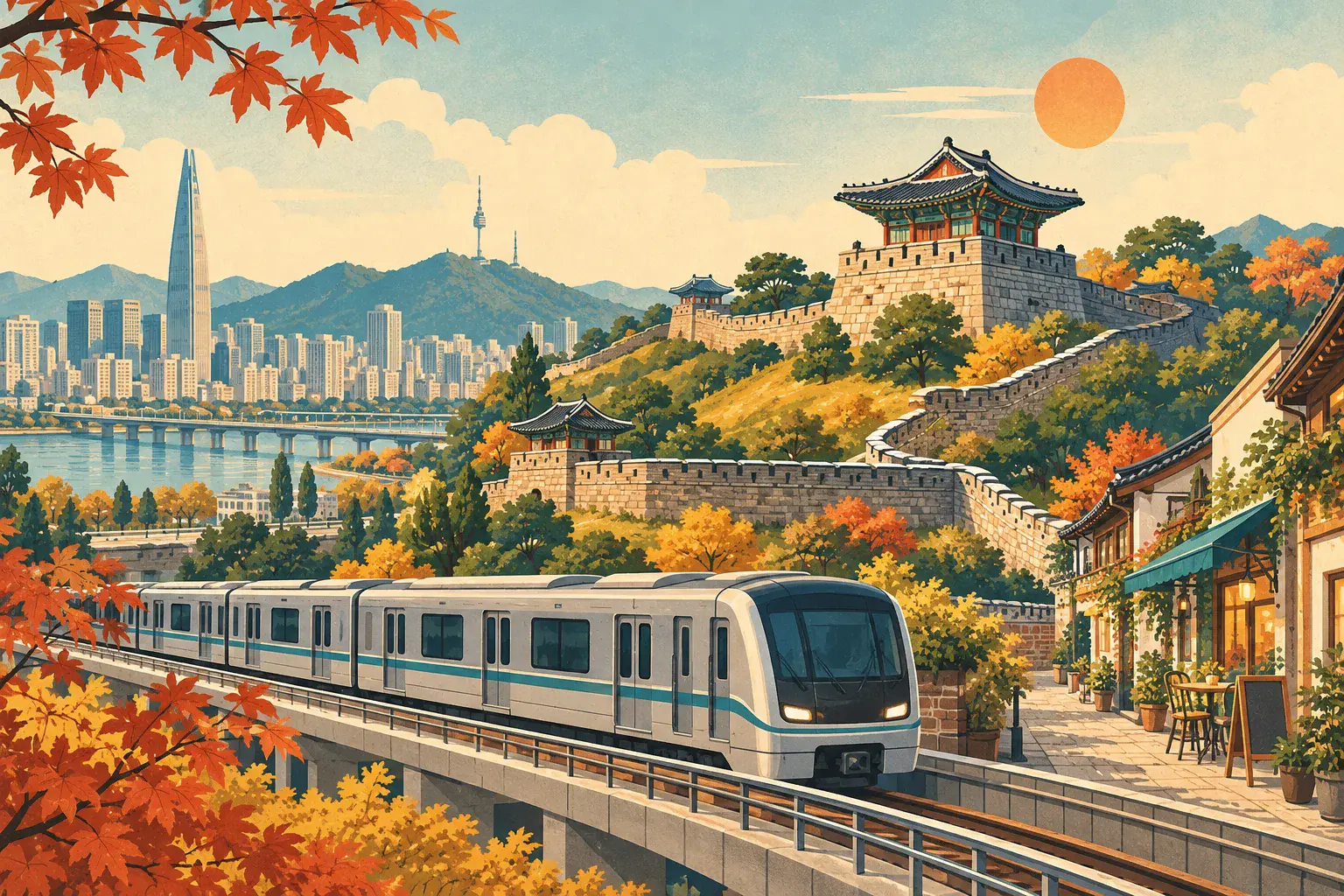
Give yourself a full day in Suwon. Walk the fortress walls, duck into Haenggung-dong for coffee, and leave the evening open for dinner and a small neighborhood bar. It is the kind of day that makes a Korea trip feel less like a list of landmarks and more like somewhere you want to return to.
That is the idea behind these 10 must-visit subway stops in Korea. The focus is Seoul and nearby Suwon, not every city in the country. Some stops deserve an entire day; others are ideal for an evening, a particular performance or a travel-day meal. You do not have to give them equal time.
For each stop, you will find things to do, practical advice and a matching Self Seed station-sign souvenir. Most are stickers; Suwon links to a photographic print, and Myeongdong to a magnet. Choose the place first and the keepsake second.
Pick your kind of day
- Fortress walls and independent cafes: Suwon.
- A musical and dinner: Sindorim.
- Design shops and cafe-hopping: Seongsu.
- A city walk before or after a train: Seoul Station.
- Coffee, small bars and a historical detour: Hapjeong.
- A grand square, palace views and museums: Gwanghwamun.
- A neighborhood shopping and dining evening: Nowon.
- Skincare shopping and street-food browsing: Myeongdong.
- A practical airport-side meal or shopping break: Gimpo Airport.
- International restaurants and nightlife: Itaewon.
Time suggestions below are planning allowances, not fixed tour durations. Add travel from your accommodation and check current venue schedules.
1. Suwon: the day trip worth giving a whole day
Station: Suwon (수원). Lines: Line 1 and Suin-Bundang. Allow: A full day, including your travel from Seoul.
If you choose one trip beyond central Seoul, make a serious case for Suwon. Hwaseong Fortress is the reason to arrive; Haenggung-dong is the reason to linger. Rather than rushing through a landmark and getting back on the train, you can build a satisfying day around walking, eating and exploring.
The fortress walls, gates and pavilions trace a route of roughly 5.7 kilometers around the historic center. You do not need to complete the whole circuit. A shorter section around Hwaseomun, Janganmun and Hwahongmun gives you striking architecture and plenty of chances to pause. The Paldalsan side involves climbing, so match the route to your energy, the weather and anyone traveling with you.
Then head into Haenggung-dong and Haengnidan Street. This is where Suwon becomes more than a history excursion. Look for small independent coffee shops, bakeries, design-led cafes and restaurants tucked into the streets around the palace and walls. Choose somewhere because you like its atmosphere, not because you feel obliged to join the longest queue. Return to the neighborhood in the evening for dinner and a small bar, checking individual opening days before building a plan around one venue.
A day that actually works:
- Arrive at Suwon Station and take a local bus or taxi to the fortress district.
- Walk a manageable section of the walls while you have fresh legs.
- Visit Hwaseong Haenggung Palace if its opening schedule suits your day.
- Spend the afternoon around Haenggung-dong, with time for a proper coffee break rather than just a takeaway.
- Have dinner nearby, followed by a neighborhood bar if you want an evening out, then leave enough time for your return train.
Important: The fortress is not immediately outside Suwon Station. Plan the onward connection rather than treating the station arrival as the start of the wall walk. Also, Hwaseong Fortress is in Suwon; do not confuse it with traveling to the separate city of Hwaseong.
This is a particularly good choice for travelers who enjoy walking and independent places more than spending an entire day in a mall. It is also a reason to leave a little space in your itinerary: discovering a cafe you want to sit in for an hour is a successful afternoon, not a delay.
Bring a little of Suwon home with this Suwon station photographic print for your desk or travel wall, a reminder of fortress walks and long cafe afternoons.
2. Sindorim: turn a transfer into a theater night
Station: Sindorim (신도림). Lines: 1 and 2. Allow: A meal and a performance, with extra time to find the theater entrance.
Sindorim is a major interchange, but it can be a destination if you plan around a show. D-Cube Link Arts Center is the draw: a large musical theater close to the station, with productions listed through Korean ticketing platforms. Pick a performance first, then make an evening of dinner and the show rather than arriving with no idea what is playing.
Check the performance language, age restrictions, runtime and any available subtitles before booking. A familiar musical can still feel very different when you do not speak the language, and not every production supplies translated captions.
There is an important correction to older shopping guides: Hyundai Department Store D-Cube City closed in 2025. The theater listing remains separate and gives its own access instructions. Follow those current directions instead of planning a shopping day around the former department store.
If you have daylight to spare, consider a walk along a nearby section of Dorimcheon, checking the access route and avoiding stream paths during heavy rain or closures. Sindorim is an option for travelers who like a specific evening plan and a glimpse of everyday southwestern Seoul, rather than another palace-and-souvenir circuit.
Make it better: Save your ticket and theater-entry instructions before arriving. A station connection does not mean you will be at your seat two minutes after leaving the train.
Keeping your theater ticket? Add a Sindorim station sticker to the same journal page and turn the evening into a keepsake.
3. Seongsu: old industrial buildings and new ideas
Station: Seongsu (성수). Line: 2. Allow: Half a day.
Seongsu suits travelers who enjoy cafes, design shops and seeing older industrial buildings used in new ways. The neighborhood combines permanent businesses with a changing calendar of brand pop-ups, so a plan based entirely on a social-media post can date quickly.
Choose a few permanent stops, then treat any pop-up you encounter as a bonus. Check whether reservations are required before queueing. For a more relaxed outing, continue toward the Seoul Forest side of the wider area.
Make it better: Alternate shopping with sitting down. You will notice more of a neighborhood when you are not racing between queues.
Give your laptop a little Seongsu personality with a Seongsu station sticker, ready for your next cafe work session.
4. Seoul Station: make your arrival more than a transfer
Station: Seoul Station (서울역). Connections: Lines 1 and 4, Airport Railroad and other rail services. Allow: A few hours if your schedule permits.
Seoul Station is often treated as a place to leave as quickly as possible. With time and a manageable bag, it can also be the start of a walk on Seoullo 7017 and an exploration toward the Namdaemun area.
The historic station building, Culture Station Seoul 284, hosts cultural programming; check the current schedule rather than assuming an exhibition will always be open. Do not turn a tight airport connection into a sightseeing gamble.
Make it better: Factor in luggage storage, the walk back, platform access and the departure time of your actual train, not just the time you return to the station entrance.
Start your travel notebook with a Seoul Station sticker and fill the pages with the places that journey took you.
5. Hapjeong: independent cafes, dinner and a riverside detour
Station: Hapjeong (합정). Lines: 2 and 6. Allow: Half a day into the evening.
Hapjeong suits the kind of afternoon when you want to wander, find a coffee shop with a little personality and let dinner happen nearby. Explore the streets toward Sangsu for cafes, restaurants and bars, then choose somewhere you actually want to sit rather than trying to photograph every storefront.
For a change of pace, make a separate walking loop toward the Jeoldusan Catholic Martyrs’ Shrine and Yanghwajin Foreign Missionary Cemetery. Visit Seoul includes these places in a historical walking route beginning at Hapjeong. They are religious and memorial spaces, so check visiting arrangements, keep noise down and treat them as more than backdrops.
The wider route can bring you toward the Han River, but the waterside is not immediately outside the platform. Check the pedestrian route and allow time for crossings and slopes. You can keep the day entirely cafe-focused if the weather or your energy suggests otherwise.
Make it better: Choose either a longer historical walk or an extended cafe afternoon as the main event. Both can work, but neither improves when you rush it.
Make your everyday water bottle a reminder of coffee stops and neighborhood walks with this Hapjeong Line 6 sticker.
6. Gwanghwamun: the big Seoul view, with history behind it
Station: Gwanghwamun (광화문). Line: 5. Allow: Half a day.
Come above ground for Gwanghwamun Square, with its statues, broad views and the palace gate anchoring the scene. This is a good place to get your bearings in the historic city before disappearing into smaller streets.
From the square, continue toward Gyeongbokgung Palace if you have time for a proper visit, or choose the National Museum of Korean Contemporary History for more context. The Sejong Center for the Performing Arts and the large Kyobo bookstore give you other ways to shape the day. A bookshop browse is particularly welcome when the weather turns.
The palace has its own opening days, admission arrangements and entrances. Reaching the square is not the same as having entered the palace grounds, so check the timetable before making it your final stop of the afternoon.
Make it better: Allow some time to stand still. This is one of the stops where the relationship between mountains, historic architecture and the modern city is part of what you came to see.
Mark a favorite page in your Korea scrapbook with a Gwanghwamun Line 5 sticker, alongside your palace photos and museum tickets.
7. Nowon: a neighborhood evening beyond the usual tourist circuit
Station: Nowon (노원). Lines: 4 and 7. Allow: An afternoon or evening, especially if you are already in northeastern Seoul.
Nowon is a different proposition from a palace or observation deck. Come for Nowon Culture Street and the surrounding restaurant, shopping and nightlife area. Have a Korean meal, browse the streets, then choose a cafe, bar or noraebang, a private karaoke room, if that suits your group.
Its appeal is an evening in a neighborhood where people live, shop and meet friends. There is no need to oversell it as a secret with no visitors or promise it will always be cheaper than central Seoul. Pick it because this kind of everyday city experience interests you.
Be careful with district-wide attraction lists. Nowon Light Garden and the former Hwarangdae railway station are elsewhere in Nowon-gu, not outside Nowon Station. If you want to add them, plan a separate onward journey. The shared district name is not a walking-distance guarantee.
Make it better: On a very short first trip, prioritize your strongest interests. Nowon makes more sense as an intentional neighborhood evening than as a distant detour taken only to increase your station count.
Remember your Nowon dinner or karaoke night with a Nowon station sticker for your phone case.
8. Myeongdong: skincare shopping and an evening food walk
Station: Myeongdong (명동). Line: 4. Allow: A few hours, preferably including the evening.
Myeongdong is an easy introduction to Seoul’s shopping streets, especially if you want cosmetics, skincare and the bustle of an evening food walk. Treat the stalls as a chance to sample a few things rather than assuming every snack is a full meal or a bargain.
Take a quieter break around Myeongdong Cathedral, respecting worship and access arrangements. Namsan can extend the outing, but it requires additional walking or transport: the station does not put you directly at the tower.
Make it better: Set a shopping list before going into beauty stores. Compare sizes and product labels, and leave enough time for a proper dinner if you need one.
Grab a Myeongdong station souvenir magnet for your fridge to remember your trip, from skincare discoveries to your favorite street-food snack.
9. Gimpo Airport: a useful final stop, not just a platform change
Station: Gimpo Airport (김포공항). Connections: Lines 5 and 9, the Airport Railroad, Gimpo Goldline and Seohae Line. Allow: Only the time your flight or onward journey genuinely leaves free.
Gimpo Airport is the practical wildcard on this list. If you are already arriving, departing or changing trains here, Lotte Mall Gimpo Airport gives you a convenient way to fit in a meal, shopping or an indoor break. Korea Tourism Organization lists the complex’s rail connections, making it a sensible alternative to trying to squeeze a distant neighborhood into a short airport window.
Look around the mall, choose a proper meal and keep the plan simple. This is not a reason to travel across Seoul solely to tick off an airport. It is a way to make travel-day downtime more pleasant when the stop already fits your route.
Gimpo and Incheon are different airports. Check the airport code and terminal on your booking, then leave enough time for terminal access, check-in and security. Do not assume an airport train stops at every airport station: confirm the service and destination before boarding.
Make it better: Work backward from the time you must be at your terminal, not the flight departure time. Shopping is optional; making the flight is not.
Slap a Gimpo Airport station sticker on your luggage and take a little piece of your Korea trip on the next adventure.
10. Itaewon: make an evening around dinner
Station: Itaewon (이태원). Line: 6. Allow: An evening, or longer for the surrounding hills.
Itaewon offers a different kind of Seoul food outing, with a wide mix of international restaurants and bars. Pick a restaurant you are excited about, then explore nearby streets rather than treating the neighborhood only as a late-night destination.
If you extend toward other areas such as Hannam or Haebangchon, check the walking route and gradients. These are not all the same neighborhood, and a seemingly short connection can involve hills.
Make it better: Check the last train for your actual destination before the evening starts. If streets become too crowded, choose a quieter route and avoid bottlenecks.
Give your tablet case a travel story with this Itaewon station sticker, a small reminder of a great dinner and a night out with friends.
Three ways to turn these stops into a trip
The Suwon day: do less, enjoy more
Keep Suwon as its own outing. A fortress walk, Haenggung Palace, coffee and dinner already make a satisfying day. If you want to stay for a bar, check your return journey first. Do not undo the relaxed pace by promising yourself three more Seoul attractions that evening.
Central Seoul: choose two good stops
Gwanghwamun and Myeongdong can work on the same day if you choose your activities sensibly: history and a museum first, shopping and dinner later. Seoul Station is useful when your arrival or departure already puts you there. You do not need to visit it simply because it is on the list.
Follow an interest rather than a train line
Give Seongsu a cafe-and-design afternoon, Hapjeong a separate neighborhood evening, or Sindorim a night built around a musical. Nowon is worthwhile for a northeastern-Seoul outing, while Itaewon suits dinner with a group whose food preferences vary. Gimpo Airport belongs on the travel day when it is useful, not on a sightseeing schedule just to fill a gap.
Subway habits that save time and wrong turns
Save both station names and destination addresses. English spellings can vary, so the Korean name helps confirm the right place. A neighborhood name, a station name and a particular attraction can refer to different locations.
Check the exit, not just the station. Large interchanges can involve long passageways, and the exit nearest your destination may differ from the first one you see. If you need a lift, check the accessible route before following a staircase crowd.
Read the train’s destination. Branches, express services and short-running trains mean that a familiar line number alone is not enough. Use current journey planning in Naver Map, KakaoMap or an operator’s app. Line 1 journeys toward Suwon especially deserve a destination check.
Plan your last train before your first drink. The last service depends on the day, direction and destination, and your connection may finish before the line’s overall service does. A general claim that trains run until midnight is not a guarantee you can get home at midnight.
Keep walking plans flexible. Fortress steps, slopes, summer heat and heavy rain change what feels comfortable. Use official paths, respect weather closures, and keep away from streamside routes during flooding risks.
Check individual businesses. A lively neighborhood does not mean every cafe, museum or bar opens daily. Save a second option nearby instead of making an entire afternoon depend on one shop.
Choose a souvenir that means something to you
A station design works as a keepsake because it points to a memory: the stop you used every morning, the evening you found a favorite restaurant, or the train that took you to Suwon’s fortress.
The ten links above go to the specific Self Seed products for those stops, rather than a general marketplace search. Check the product format and selected options on Redbubble before ordering. A photographic print, magnet and sticker are different products, even when they belong to the same station-sign collection.
Prefer to wear your favorite stop? These station designs also have shirt and hoodie options on Redbubble. Open the linked design and browse its other products to choose a wearable version, then check the available sizes, colors and print placement.
If you only make one plan from this guide, make it a generous one. Walk until you want coffee. Stay somewhere because you like it. And give Suwon enough time to show you why a day outside central Seoul can become the day you remember most.
For another way to think about an unhurried itinerary, read our guide to why slow travel can be more meaningful.
Sources and trip planning
- Korea Tourism Organization: Haengnidan Street in Suwon
- KoreaToDo: Suwon Hwaseong Fortress walking routes and station access
- Visit Seoul: exploring the city by subway, including Gwanghwamun
- NOL World: D-Cube Link Arts Center and current theater access
- Visit Seoul: a historical walking route from Hapjeong
- The Seoul Guide: Nowon Culture Street
- Visit Seoul: Gongneung-dong and the separate Hwarangdae attractions
- Korea Tourism Organization: Lotte Mall Gimpo Airport
Consult current operator and venue information for fares, opening times, admission and service changes.
Cover: an original AI-generated travel illustration combining Seoul and Suwon themes, not a photograph or a literal rail-route map.
Worth sharing?
Send this to someone who would find it useful.