Debt Paydown Strategies, Avalanche vs Snowball vs Hybrid
Published
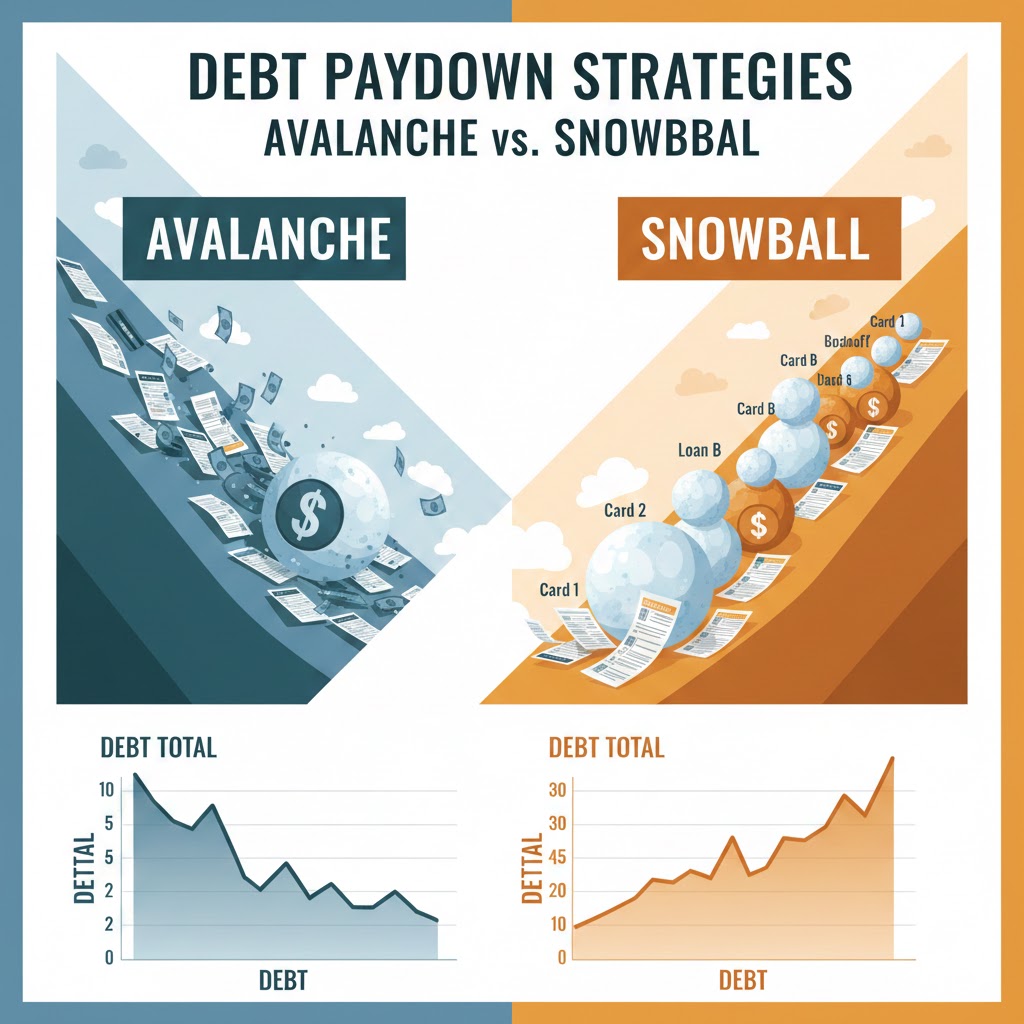
Debt Paydown Strategies: Avalanche vs Snowball vs Hybrid (With Timelines and Motivation Modeling)
If you’ve ever Googled “best way to pay off debt,” you’ve seen the same two camps arguing past each other: the debt avalanche method (mathematically optimal) versus the debt snowball method (psychologically powerful). Both can work. Both can fail. And most people don’t fail because they chose the “wrong” formula. They fail because their plan didn’t survive real life: motivation dips, surprise expenses, or the slow grind of months where progress feels invisible.
In this guide, I’m going to treat debt payoff like what it is: a cash-flow problem with human behavior attached. We’ll compare avalanche vs snowball vs a practical hybrid approach, model outcomes by interest rate and balance size, and include payoff timelines so you can see what each strategy looks like in the real world.
This is meant to be the last debt paydown strategy article you need to read.
The Three Approaches, Explained Like a Human
The Debt Avalanche Method (Highest Interest First)
With debt avalanche, you pay minimums on every debt, then throw all extra money at the balance with the highest APR. When that’s gone, you roll that payment into the next-highest APR.
If your only goal is to minimize total interest and get debt-free as efficiently as possible, avalanche is usually the winner. It’s also the method most personal finance pros recommend when they’re being purely analytical.
The catch is emotional: if your highest APR debt is also your biggest balance, you can spend months paying aggressively while the principal barely seems to move. That’s where motivation can erode.
The Debt Snowball Method (Smallest Balance First)
With debt snowball, you pay minimums on everything, then target the smallest balance first. When it’s paid off, you roll that payment to the next-smallest balance.
Snowball is not “wrong,” it’s behaviorally smart. It manufactures quick wins. Those early wins can create momentum, reduce overwhelm, and keep you consistent. Consistency beats a perfect plan that you abandon after six weeks.
The tradeoff is math: you can pay more interest over time if high-APR balances sit around longer.
The Hybrid Method (Optimize for Both Math and Momentum)
Hybrid debt payoff is the strategy people tend to invent after living with debt for a while. It blends the best parts of snowball and avalanche. There are a few flavors, but the core idea is consistent:
You prioritize motivation first just long enough to lock in the habit, then pivot hard into interest optimization.
A good hybrid plan is not indecisive. It’s intentional. And for most households, it’s the most sustainable debt paydown strategy.
The Real Variables That Actually Decide Your Best Strategy
Most articles pretend the choice is simply “math vs feelings.” In practice, your best debt payoff plan depends on three variables:
Interest rate spread. If your APRs are close together (say 17 percent vs 19 percent), avalanche saves less than you think. If there’s a wide spread (like 7 percent student loan vs 29 percent credit card), avalanche can save a lot.
Balance distribution. If your smallest balances are tiny and your highest interest debt is huge, snowball creates quick wins while avalanche may feel like pushing a boulder uphill.
Motivation decay. This is the one nobody quantifies, but everyone experiences. Motivation tends to decline when there are no visible milestones. If you’re the kind of person who needs progress you can see, snowball or hybrid often beats avalanche in the real world.
A plan you follow is better than a plan you admire.
A Simple Motivation Model (And Why It Matters)
Here’s the practical way I model motivation decay when choosing avalanche vs snowball vs hybrid:
Every month you don’t eliminate a debt account, your enthusiasm drops slightly. Every payoff event creates a surge in commitment because you feel progress and complexity reduces.
If your plan takes six to nine months before you close your first account, you’re relying on discipline alone. Some people can do that. Most people don’t want to.
A hybrid method essentially buys you a quick win or two early on, then transitions to the interest-heavy targets once your behavior is stable.
The Example Setup (Same Debt, Same Payment, Three Different Results)
To keep the comparison honest, we’ll use the same debts and the same monthly payoff budget in each scenario.
Assumptions:
- You make minimum payments on all debts.
- You have $1,000 per month total to put toward debt.
- Interest compounds monthly (typical consumer debt behavior).
- Minimums are approximations for illustration.
- No new debt is added.
Debts:
- Credit Card A: $1,200 at 24% APR, minimum $40
- Credit Card B: $4,800 at 18% APR, minimum $120
- Personal Loan: $9,500 at 11% APR, minimum $210
- Student Loan: $18,000 at 5.5% APR, minimum $200
Total minimums: $570
Extra available to target: $430
Total monthly debt budget: $1,000
This is a pretty normal mix: one small card, one bigger card, a mid-rate installment loan, and a lower-rate student loan.
Payoff Timelines: Avalanche vs Snowball vs Hybrid
Timelines are approximate, but directionally accurate. Small differences happen based on exact minimum formulas and daily interest, but the pattern holds.
1) Debt Avalanche Timeline (Highest APR First)
Order: 24% card → 18% card → 11% loan → 5.5% student loan
With avalanche, you kill the 24% card first (good), then you spend meaningful time attacking the 18% card while the loan and student loan sit on minimums.
Approximate timeline:
- Credit Card A ($1,200 at 24%): about 2 months
- Credit Card B ($4,800 at 18%): about 7 to 8 months total (month 9 or 10 payoff)
- Personal Loan ($9,500 at 11%): about 11 to 12 more months
- Student Loan ($18,000 at 5.5%): about 16 to 18 more months
Estimated debt-free time: around 36 to 40 months
Estimated interest paid: lowest of the three strategies
Avalanche tends to win the interest race, especially because it prioritizes the expensive revolving debt.
The drawback is the middle stretch. You only close two accounts in the first 9 to 10 months. If you’re prone to “this is taking forever” fatigue, this is where you may wobble.
2) Debt Snowball Timeline (Smallest Balance First)
Order: $1,200 card → $4,800 card → $9,500 loan → $18,000 student loan
In our example, the order looks similar to avalanche at first because the smallest debt is also the highest APR. That’s not always the case, but it’s common.
Where snowball differs is when balance size conflicts with APR. If a low-APR small balance exists, snowball pays it off early for momentum, even if the APR is not the worst.
Approximate timeline in this scenario:
- Credit Card A: about 2 months
- Credit Card B: about 8 to 9 months total
- Personal Loan: about 11 to 13 more months
- Student Loan: about 16 to 18 more months
Estimated debt-free time: around 37 to 41 months
Estimated interest paid: slightly higher than avalanche
In this particular setup, snowball and avalanche finish at similar times because the debt sizes and APRs align reasonably well. The bigger difference shows up when you have a tiny low-interest debt and a massive high-interest card. Snowball can cost noticeably more interest then, but it may keep you on track.
3) Hybrid Timeline (Momentum First, Then APR Optimization)
Here’s the hybrid approach I recommend most often when motivation is a factor:
Step 1: Pay off one or two small balances quickly for psychological wins.
Step 2: Switch to avalanche for the remaining debts.
In this example, you’d do:
- Knock out Credit Card A quickly (same as both methods).
- If you had another small balance, you’d clear it too. Since we don’t, we pivot into the highest APR remaining.
So the hybrid looks like:
Credit Card A → then avalanche (18% card → 11% loan → 5.5% student loan)
Approximate timeline:
- Credit Card A: about 2 months
- Credit Card B: about 7 to 8 months total
- Personal Loan: about 11 to 12 more months
- Student Loan: about 16 to 18 more months
Estimated debt-free time: around 36 to 40 months
Estimated interest paid: near-avalanche, sometimes identical in practice
Hybrid often lands within spitting distance of avalanche on interest, while behaving more like snowball emotionally because you structure early wins intentionally.
If you want the most practical option for most people, it’s this.
What If Snowball and Avalanche Give a Very Different Result?
Let’s talk edge cases, because that’s where strategy choice matters.
Edge Case A: Your Highest APR Debt Is Huge
Example: $22,000 at 29% APR on a credit card, plus two small debts at 6% and 9% APR.
Debt avalanche is mathematically urgent. That 29% APR is on fire.
But if you need a visible win to stay motivated, a hybrid plan is usually smarter than pure snowball. Pay off one tiny balance in 30 to 60 days, then go straight to the 29% card. You get the win without letting the high-APR monster grow.
Edge Case B: Your APRs Are All Similar
If everything is around 10% to 14%, the difference between avalanche and snowball is smaller than people think. In that case, snowball is often the better choice because it improves adherence, simplifies your finances, and reduces cognitive load.
Edge Case C: You’re One Emergency Away From Re-Accumulating Debt
If you don’t have a basic emergency fund and you’re using credit cards when life happens, your paydown strategy is less important than your stability.
In that case, the best debt payoff plan usually starts with a starter buffer, even if it slows payoff slightly, because it prevents relapse. A $500 to $1,500 cash buffer can keep your debt payoff timeline from resetting to zero.
Choosing the Best Debt Paydown Strategy for You
Most people ask, “Which method is best?” The better question is, “Which method will I actually execute for 12 to 36 months?”
If you’re analytical, consistent, and not emotionally rattled by slow early progress, the debt avalanche method is typically the best way to pay off debt fast with the least interest.
If you’re overwhelmed, tired of juggling multiple lenders, or you’ve restarted debt payoff plans before, the debt snowball method may be the fastest path to debt freedom in real life, even if it’s not the cheapest on paper.
If you want the best blend, hybrid debt payoff is often the sweet spot: quick wins to protect motivation, followed by interest-rate optimization to protect your wallet.
A Practical Hybrid Plan You Can Use Tonight
Start by listing every debt with four fields: balance, APR, minimum payment, and due date. Then do this:
First, commit to never missing minimums. Your credit score and your interest costs both get worse if you slip.
Second, choose a “momentum target.” This is usually the smallest balance you can eliminate in 30 to 90 days. You’re not doing this because math is irrelevant. You’re doing it because follow-through is the entire game.
Third, once you get that first payoff, switch to avalanche on the remaining debts unless your motivation is still fragile. If it is, pay off a second small balance, then pivot.
This is the hybrid method in its most effective form: a short snowball on-ramp, then a long avalanche runway.
The One Thing That Changes Every Timeline: Your Monthly “Extra”
People obsess over strategy and ignore the lever that matters most: the amount you can consistently apply above minimums.
If you add even $100 more per month to the plan, your payoff timeline often drops by months. If you add $300, it can drop by a year or more depending on APR. The best debt payoff strategy is the one that also includes a realistic plan to increase your surplus, whether that’s trimming recurring expenses, renegotiating bills, selling a second car, or picking up a short-term side income.
Strategy decides efficiency. Surplus decides speed.
Final Take: Avalanche vs Snowball vs Hybrid
Debt avalanche is the best mathematical answer. Debt snowball is the best emotional answer. Hybrid is the best real-life answer for a lot of people because it respects the math and the human.
If you want a simple rule that’s hard to regret: take one quick win, then attack interest rates like a professional.
Because once you feel progress and you’re no longer juggling as many payments, debt payoff stops being a constant fight and starts becoming a routine. And routines are how people actually get debt-free.
Worth sharing?
Send this to someone who would find it useful.