Best High-Yield Savings Accounts for May–June 2026: SoFi's 4.50% vs Varo's 5.00% vs Axos, Newtek, and AdelFi — Ranked by Real After-Inflation Return, Withdrawal Rules, and Fine Print
Published
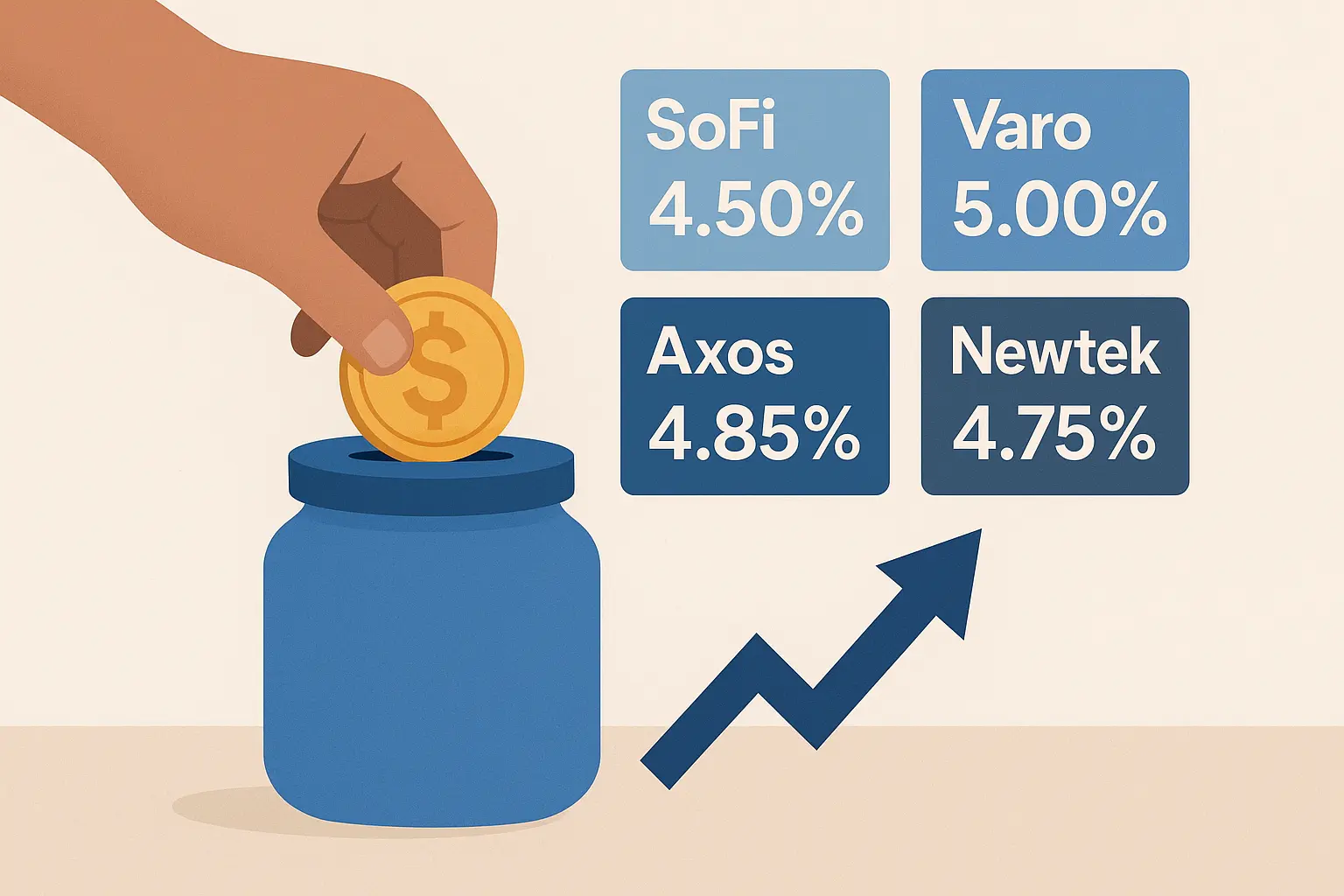
Best High-Yield Savings Accounts for May–June 2026: What You Actually Earn After Inflation, Taxes, and Fine Print
A 5.00% APY sounds fantastic until you do the math on a $25,000 balance at AdelFi and realize you’d actually earn a blended rate of about 0.68%. Not a typo. That gap between headline rates and what actually lands in your account is exactly why most HYSA comparison articles are kind of useless.
This is the deeper follow-up to our earlier roundup of the best high-yield savings accounts for 2026, which covered the account-by-account basics. What that piece skipped: after-inflation real yields, after-tax effective returns, blended APYs on realistic balance sizes, and an honest verdict on which accounts have deal-breaking fine print. There’s also a section on the Fed’s likely rate-cut timeline, because “park your cash at 4.50%” looks different if rates are at 3.50% by December.
The Real-Yield Ladder: What These Accounts Actually Pay You
Most comparison sites rank by headline APY and call it a day. Your purchasing power depends on what’s left after inflation eats into your return and the IRS takes its cut, and those two things together do a lot of damage.
CPI is running at roughly 2.8% year-over-year per the Bureau of Labor Statistics, with core PCE tracking closer to 3.7% on some Cleveland Fed nowcasting models. Even a “high-yield” account might barely keep pace with rising prices once taxes enter the picture.
HYSA interest is ordinary income, reported on Form 1099-INT. For a saver in the 22% federal tax bracket, a 4.21% APY becomes approximately 3.28% after federal taxes. Subtract 2.8% inflation and your real after-tax return is roughly +0.48%. That’s the actual reward for choosing this account over a mattress.
The Real-Yield Comparison (22% federal tax bracket, 2.8% CPI)
| Account | Headline APY | After-Tax Yield | Real After-Inflation Return | Key Condition |
|---|---|---|---|---|
| Varo (qualifying) | 5.00% | 3.90% | +1.10% | Balance ≤$5K + spending minimums |
| AdelFi / CCCU (≤$5K) | 5.00% | 3.90% | +1.10% | Balance ≤$5K only; CCCU membership |
| SoFi (with direct deposit + boost) | 4.50% | 3.51% | +0.71% | Eligible direct deposit required |
| Axos (qualifying) | 4.21% | 3.28% | +0.48% | Qualifying deposits needed |
| Newtek | ~4.00–4.20% | ~3.12–3.28% | +0.32–0.48% | No hoops |
A few things worth noting. The gap between the “best” and “worst” accounts shrinks dramatically once you account for taxes and inflation. The 80-basis-point spread between Varo’s 5.00% and Newtek’s rate compresses to roughly 60–78 cents of real return per $100 per year. And every account with a high headline rate has qualification strings attached, which means a lot of savers quietly earn well below the advertised number without realizing it.
Also, before you pick something off a national ranking: if your state taxes interest income (most do), your real return drops further. A California resident in the 9.3% state bracket earning 4.50% APY keeps about 3.08% after all taxes, for a real return of just +0.28%. Run those numbers for your actual state.
Account-by-Account Breakdown: The Fine Print That Changes Everything
Varo: 5.00% APY (With a Ceiling and a Catch)
Varo’s headline rate leads the pack, but it applies only to balances up to $5,000, and only if you meet monthly qualification requirements including minimum debit card purchases. Balances above $5,000 earn a sharply lower rate.
On a $5,000 balance that fully qualifies, you’d earn about $250 in a year before taxes. On a $25,000 balance, the vast majority sits at the lower tier and your blended yield drops well below what competitors offer without any hoops at all.
Varo’s 5.00% is real. It’s just built for people using Varo as their primary spending account, not as a serious savings vehicle for anything above pocket-money amounts. If your balance exceeds $5,000 and you don’t want to micromanage monthly spending thresholds, move on.
AdelFi (Christian Community Credit Union): The Sharpest Cliff in the Market
AdelFi advertises 5.00% APY, and on balances up to $5,000 that’s exactly what you get. The rate schedule published on their site tells a very different story above that threshold:
- $0–$5,000: 5.00% APY
- $5,001–$10,000: 2.25% APY
- $10,001+: 0.10% APY
That 0.10% tier is not a typo. It’s the rate on every dollar above ten thousand. On a $25,000 balance, your blended effective yield works out to approximately 0.68%, which is worse than many traditional brick-and-mortar savings accounts. Possibly the single worst headline-versus-reality gap in the current HYSA market.
The dollar math: on $25,000 for one year, the first $5,000 earns $250, the next $5,000 earns $112.50, and the remaining $15,000 earns $15. Total: $377.50, a blended 1.51%. Push that to $50,000 and the blended rate falls to about 0.83%.
There’s also a membership requirement worth knowing about upfront. AdelFi operates through Christian Community Credit Union, and membership requires affiliation with the Christian faith community. This account simply isn’t available to everyone. Minimum opening deposit is $100, and there’s a $5 monthly fee if your balance drops below that.
Skip AdelFi if you plan to save more than $5,000. The blended math falls apart fast and there’s no way around it.
SoFi: 4.50% APY (a Three-Layer Sandwich)
SoFi’s 4.50% is actually a composite: a base rate of roughly 3.30%, plus a 0.70% APY Boost for new accounts (limited-time, with an expiration that SoFi has historically shifted around), plus an eligibility requirement to route an Eligible Direct Deposit or make Qualifying Deposits into your SoFi account.
Without direct deposit, the rate drops to approximately 1.20%. A 3.30-percentage-point penalty for not meeting the qualification is among the steepest conditional gaps in the industry.
The boost layer deserves its own side-eye. SoFi has a pattern of introducing, extending, and then quietly modifying or expiring these promotional rate bumps. If you open an account counting on 4.50% for the long haul, you may find yourself at 3.30% or lower six months later when the promotional component quietly expires. I’d treat the boosted rate as a nice bonus, not something to budget around. I’ll admit I’m slightly less cynical about SoFi’s overall product than some people are, but the promo-rate history is real and documented.
That said, SoFi doesn’t cap the balance that earns the full rate, assuming you qualify. That makes it meaningfully better than Varo or AdelFi for savers with $10,000 or more. No monthly fees, no minimum balance requirement, FDIC-insured through partner banks. If you’re already thinking about SoFi as a primary banking relationship, our guide to improving your credit score in 2026 covers how their bundled products can work together.
Skip SoFi if you don’t have a paycheck or regular income you can route via direct deposit, or you’re not comfortable with a promotional rate that could change without much notice.
Axos Bank: 4.21% APY (Conditional, but Broad)
Axos offers a competitive rate that requires qualifying deposits but doesn’t impose the tiny balance caps that plague Varo and AdelFi. Not the highest headline number, but the rate applies more broadly across your balance, which matters a lot once you’re saving more than $10,000.
No monthly fees, FDIC-insured, entirely online. The qualification requirements center on maintaining qualifying deposits, typically direct deposits or certain transfer types. Lower behavioral bar than Varo’s spending minimums, which is a real advantage if you don’t want to think about it month to month.
The case against Axos is basically: if you want zero conditions and don’t need the extra basis points, Newtek is simpler. If you need branch access, neither of these is your answer.
Newtek Bank: The No-Hoops Option
Newtek won NerdWallet’s 2026 Best-Of Award and it’s not hard to see why. No monthly fees, no minimum balance, no spending requirements, no promotional gimmicks. The rate (in the low-to-mid 4% range) isn’t the highest on this list, but it’s the rate you’ll actually earn on your whole balance, today and three months from now. FDIC-insured, online-only, and you can open an account in about two minutes.
The real-yield math puts Newtek at roughly +0.32–0.48% after taxes and inflation. Modest. But if you want to park $30,000 or $50,000 without worrying about tier cliffs, spending minimums, or promotional expirations, that simplicity is worth something. Honestly, for most people with balances above $10,000 who just want to set it and forget it, this is probably the right call.
Skip Newtek if you’re willing to do the behavioral work to qualify for higher conditional rates elsewhere, or you need features like check-writing or debit access (in which case, our comparison of money market accounts vs. HYSAs is the better starting point).
The Blended APY Table Nobody Else Publishes
Most reviews show the headline rate. Here’s what you’d actually earn on common balance sizes, annualized, before taxes:
| Balance | Varo (qualifying) | AdelFi | SoFi (qualifying) | Axos (qualifying) | Newtek |
|---|---|---|---|---|---|
| $5,000 | $250 (5.00%) | $250 (5.00%) | $225 (4.50%) | $211 (4.21%) | |
| $10,000 | $362 (3.63%) | $450 (4.50%) | $421 (4.21%) | ||
| $25,000 | $378 (1.51%) | $1,125 (4.50%) | $1,053 (4.21%) | ||
| $50,000 | $403 (0.81%) | $2,250 (4.50%) | $2,105 (4.21%) |
*Varo estimates based on lower non-qualifying tier above $5K; exact rate varies.
For balances under $5,000, Varo and AdelFi win on paper. Above $10,000, SoFi (if you qualify) and Axos pull away dramatically. AdelFi’s 5.00% headline becomes functionally irrelevant once you’re saving meaningful amounts. That’s really the whole point of this table.
If you’re still figuring out how much to keep in savings versus investing elsewhere, our emergency fund size calculator can help you set a target before picking an account.
Lock In Now or Wait for Rate Cuts? A Dollar-Based Decision Framework
The Fed held steady at 3.50–3.75% at its April 29, 2026 meeting, the third consecutive hold. The vote was 8–4, the most dissenters since October 1992. Three members objected to language even hinting at future cuts, while one dissented in favor of an immediate 25-basis-point cut. That’s an unusual split, and it means the path forward is genuinely uncertain in a way it wasn’t six months ago.
The CME FedWatch Tool currently prices in roughly 65–70% odds of another hold at the June FOMC meeting, with September or October as the first credible cut window. Primerates.com’s forecast projects HYSA yields declining from the current 4.25–4.75% range to 3.5–4.0% by year-end if two to three cuts materialize. Take that as a rough directional guide. These forecasts have been badly wrong before, including as recently as 2024, and I wouldn’t be shocked if the timeline slips again.
On a $30,000 balance, the difference between opening an account now at 4.50% versus waiting until Q4 and entering at 3.75% works out to roughly $105–$225 in foregone interest over six months. Not life-changing, but real. And there’s no scenario where rates go higher from here. The debate within the Fed is between cutting and holding, not between holding and hiking.
So practically:
- Open now if you have idle cash earning under 1% in a traditional savings account. Even if rates drop later, you’ll have captured months of 4%+ returns you’d otherwise miss. Variable-rate HYSAs adjust downward automatically, so you’re not locked into anything.
- Consider a CD ladder alongside your HYSA if you have cash you won’t need for 6–12 months. Twelve-month CDs are currently offering 4.75–5.25%, and those rates are locked. A split strategy (HYSA for your emergency fund, CD for money you can set aside) captures both liquidity and rate protection.
- Wait only if you genuinely need the cash within 30 days and the ACH transfer time to a new online bank (typically 1–3 business days) would create a real problem. Otherwise there’s no strategic reason to delay.
What to Watch Over the Next 90 Days
The June FOMC meeting is the next major signal. If the Fed holds again, current HYSA rates should remain stable through summer. If the statement language shifts dovish, or a cut materializes sooner than September, expect banks to begin trimming APYs within days to weeks.
Three things worth actually doing before then:
Run your own after-tax, after-inflation number. Take your marginal federal rate (and state rate, if applicable), multiply your prospective APY by (1 minus your combined tax rate), then subtract current CPI. If the result is barely positive, you’re preserving purchasing power at best. Still better than a 0.01% traditional account, but worth knowing going in.
Before you move any money: open the terms page for any account you’re considering and verify the conditions. SoFi’s direct deposit requirement, Varo’s spending minimums, AdelFi’s membership requirement. All confirmable in ten minutes. The worst outcome is transferring $20,000 to a new bank and finding out you’re earning 1.20% instead of 4.50%.
Bookmark the CME FedWatch Tool and check it before each FOMC meeting. If cut probabilities spike above 80% for an upcoming meeting, that’s your cue to think about whether shifting some savings into a fixed-rate CD makes sense. Takes thirty seconds.
Where This Ends Up
The broad trajectory for 2026 is lower rates. The only real questions are how fast and how far. The window of 4%+ HYSA yields is probably in its final months, and sitting on cash in a 0.5% account while waiting for a “better time to decide” is just quietly giving money away.
The accounts that look best in a sorted table (Varo, AdelFi) are often the worst choices for anyone saving more than a few thousand dollars. Headline APY is a marketing number aimed at people who won’t do the blended math. The accounts that look merely good (SoFi, Axos, Newtek) tend to deliver more actual dollars to savers with realistic balances.
And if your real, after-tax return on savings is under 1%, and you have funds beyond your emergency reserve, it’s worth asking whether a savings account is the right vehicle at all. For the emergency fund portion, probably yes. For the rest, that’s a different conversation.
Worth sharing?
Send this to someone who would find it useful.