Are we seeing a 5th industrial revolution with AI? Will humans still have jobs?
Published
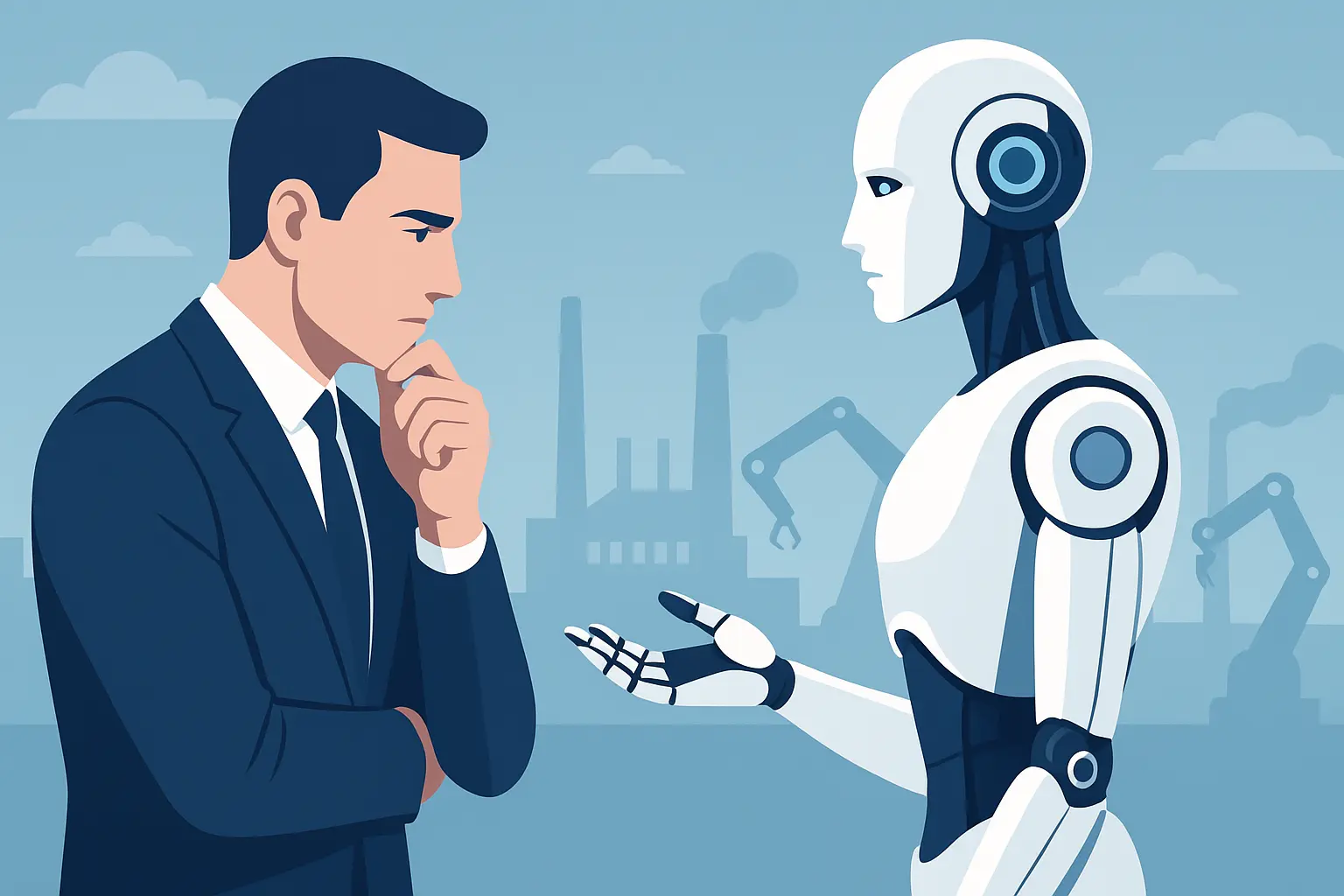
Industrial Revolutions & The Coming AI Transformation
A Complete Analysis
PART ONE: THE PREVIOUS INDUSTRIAL REVOLUTIONS
The First Industrial Revolution (1760–1840)
What Changed Technologically
The shift from hand production to machine manufacturing, centered in Britain before spreading globally. Key innovations included the steam engine, mechanized textile production, iron and steel manufacturing, and coal as a primary energy source.
Economic Changes
- Factory system replaced cottage industries and artisan workshops
- Capital became concentrated in the hands of factory owners
- Markets expanded from local to national and eventually international
- Banks and financial institutions grew to fund industrial enterprises
- GDP growth accelerated dramatically compared to agricultural economies
- Cost of manufactured goods dropped significantly over time
Job Changes
- Skilled artisans like hand-loom weavers were largely displaced
- Millions migrated from rural agricultural work to urban factory work
- Child labor became widespread in factories and mines
- The concept of “working hours” replaced seasonal agricultural rhythms
- New jobs created: factory workers, engineers, machinists, mine workers, railway workers
- The working class as a modern social category was essentially born here
Life Changes
- Mass urbanization transformed society almost entirely
- Life expectancy initially dropped in industrial cities due to terrible conditions
- Eventually improved through better goods and later public health improvements
- The concept of a “middle class” began forming
- Consumption of manufactured goods became accessible to ordinary people
- Social structures that had existed for centuries were fundamentally disrupted
- The Luddite movement emerged as a direct resistance to technological displacement
The Key Lesson
Enormous short-term suffering occurred for working people, but long-term living standards rose dramatically. The transition took roughly two to three generations.
The Second Industrial Revolution (1870–1914)
What Changed Technologically
Electrification, steel production at scale, chemicals, petroleum, and the internal combustion engine. The telephone, telegraph, and early forms of mass communication emerged.
Economic Changes
- Assembly line production pioneered by Ford created mass production
- Corporations became the dominant business structure
- Global trade networks expanded dramatically
- Consumer economy began forming as wages rose enough to purchase beyond necessities
- Scientific management and efficiency became business philosophies
- Monopolies and trusts formed, requiring new government regulatory responses
Job Changes
- Agricultural employment began its long decline in developed nations
- Factory work became more systematic, repetitive, and specialized
- White collar work expanded significantly for the first time
- Clerical workers, accountants, managers, and salespeople became major employment categories
- Women began entering the formal workforce in larger numbers
- The eight-hour workday movement emerged as a response to exploitation
Life Changes
- Electric light transformed daily rhythms completely
- Indoor plumbing and sanitation dramatically improved health outcomes
- The automobile began reshaping geography, city planning, and social life
- Mass media created shared cultural experiences at scale
- Household goods became standardized and affordable
- Life expectancy began rising substantially
- Education became more widespread as literacy was increasingly required for work
The Key Lesson
New categories of work were created that had never existed before. People did not simply replace lost jobs with the same kind of work. Entirely new economic sectors emerged.
The Third Industrial Revolution (1960s–2000s)
What Changed Technologically
Computing, digital information, automation of cognitive tasks, the internet, robotics in manufacturing, and global telecommunications networks.
Economic Changes
- Information became an economic asset as valuable as physical goods
- Globalization accelerated dramatically as communication and logistics improved
- Financial markets became interconnected globally
- Service economies displaced manufacturing economies in developed nations
- Entire industries emerged from nothing: software, internet services, mobile technology
- Supply chains became globally distributed, transforming manufacturing economics
Job Changes
- Manufacturing employment in developed nations collapsed over several decades
- Entire categories of mid-skill work were automated or offshored
- Typing pools, telephone operators, bank tellers, travel agents, and similar roles shrank massively
- Knowledge work expanded dramatically
- The college degree became the baseline credential for middle-class employment
- Gig economy models began emerging late in this period
- Income inequality increased significantly as returns concentrated in skilled cognitive workers
Life Changes
- Internet transformed communication, commerce, entertainment, and information access
- Smartphones put powerful computing in billions of pockets worldwide
- Remote work became technologically possible before it became culturally accepted
- Access to information became essentially free and universal
- Social media restructured human relationships and political discourse
- E-commerce disrupted retail and changed consumer behavior completely
- Life expectancy continued rising and global poverty declined substantially
The Key Lesson
This revolution split the workforce dramatically. Workers who could leverage technology saw wages rise substantially. Workers whose skills were replaceable by technology or offshore labor saw wages stagnate or decline. The middle of the skill distribution was hollowed out, a phenomenon economists call “job polarization.”
PART TWO: THE AI REVOLUTION, A FOURTH INDUSTRIAL REVOLUTION
What Makes This Revolution Fundamentally Different
Before examining the changes, it is essential to understand why the AI revolution is categorically different from its predecessors in ways that matter enormously.
Previous Automation Automated Physical or Routine Cognitive Tasks
Every prior revolution automated things that were:
- Physically repetitive, weaving, assembly, digging
- Routine and rule-based, data entry, calculation, simple transactions
- Narrow in scope, a machine that welded car frames could do nothing else
Human cognitive flexibility, creativity, judgment, and social intelligence remained largely safe.
AI Automates General Cognitive Capacity
For the first time, the technology being deployed:
- Reasons and problem-solves across diverse domains
- Generates creative output, writing, code, images, music, strategy
- Learns and adapts rather than following fixed rules
- Communicates in natural language with human-like fluency
- Improves rapidly and continuously through scaling and training
- Potentially extends to physical tasks through robotics
The thing being automated is not a narrow task. It is the general-purpose cognitive engine that humans use to do almost everything.
The Current State of AI Capabilities (2024–2025)
To ground this analysis in reality:
- Large Language Models perform at professional levels on bar exams, medical licensing exams, and coding assessments
- AI coding tools write functional software and are already transforming software development
- Image and video generation competes with professional creative work
- AI in drug discovery is accelerating pharmaceutical research dramatically
- Customer service AI handles increasingly complex interactions
- Autonomous vehicles are operating commercially in limited contexts
- Robotics is advancing but lags significantly behind cognitive AI capabilities
The critical observation is that cognitive AI is advancing faster than physical robotics, though both are progressing.
How AI Will Change the Economy
Productivity Explosion
Economic models suggest AI could add between 7 and 10 percent to global GDP over ten years according to Goldman Sachs projections, though estimates vary widely. The productivity gains come from:
- Fewer workers needed to produce the same output
- Dramatically faster research and development cycles
- Better decision-making at organizational levels
- New products and services that were previously impossible or economically unviable
Capital vs. Labor Shift
This is the most important economic dynamic to understand clearly.
In previous revolutions, capital was required to build physical machines that needed human operators. The machines augmented human labor. Now capital can purchase AI systems that replace the cognitive labor itself. This fundamentally shifts the balance of economic power:
- Returns increasingly flow to capital owners and AI developers
- The need for large human workforces to generate the same economic output declines
- Wage pressure on cognitive work increases even as productivity rises
- Wealth concentration could accelerate significantly without policy intervention
New Industries and Markets
As in previous revolutions, new industries will emerge:
- AI development and maintenance
- AI safety and alignment
- Human-AI interface design
- New categories of entertainment and experience economy
- Services that specifically emphasize human connection and authenticity
- Sectors enabled by AI that were previously economically impossible
Cost Deflation
When AI can perform tasks at fractions of the previous cost, the price of many goods and services will fall. This could raise real living standards broadly even while disrupting employment, similar to how manufactured goods became dramatically cheaper during the First Industrial Revolution. Healthcare, education, and legal services could become far more accessible.
How AI Will Change Jobs, Sector by Sector
Already Being Disrupted Now
Software Development
AI coding assistants already write substantial portions of code. The number of software engineers needed to produce a given amount of software is declining. Senior engineers directing AI produce the output that previously required teams. Entry-level coding jobs face severe pressure.
Customer Service
AI handles tier-one and increasingly tier-two support across industries. The large call center employment bases in countries like India and the Philippines face existential disruption.
Content Creation
Copywriting, basic journalism, marketing content, and similar work faces significant displacement. AI generates first drafts faster and cheaper than humans. Editing and strategic direction retain more human value currently.
Data Analysis and Finance
Routine financial analysis, report generation, and data processing is already largely automatable. Junior analyst roles at investment banks and consulting firms are explicitly being reduced.
Legal Work
Document review, contract analysis, and legal research are heavily automated. Paralegals and junior associates face displacement while senior strategic legal work retains value.
Radiology and Medical Imaging
AI matches or exceeds radiologist performance on specific imaging tasks. This represents a direct challenge to a high-earning medical specialty.
Being Disrupted in the Medium Term
Education
AI tutors can provide personalized instruction at scale. The current teacher role will transform significantly, though the social and developmental functions of schooling create friction against full automation.
Management and Administration
Middle management that primarily coordinates information flow and generates reports is highly automatable. Strategic and interpersonal management functions are more resilient.
Accounting and Bookkeeping
Routine accounting is substantially automatable. Tax complexity and regulatory interpretation retain some human value temporarily.
Journalism and Research
Factual reporting and research synthesis are significantly at risk. Investigative journalism requiring human relationships and judgment is more resilient.
Trucking and Transportation
Autonomous vehicles will eventually disrupt the roughly 3.5 million truck drivers in the United States alone, though regulatory and technical challenges create longer timelines than early predictions suggested.
Being Disrupted Longer Term With Humanoid Robots
Construction and Trades
Physical manipulation in unstructured environments remains difficult for robots currently. Humanoid robots capable of plumbing, electrical work, and carpentry would disrupt the trades significantly but timeline is genuinely uncertain.
Healthcare Physical Work
Nursing, physical therapy, and patient care involve complex physical manipulation and emotional connection. AI can augment these roles substantially. Full automation faces both technical and deep social resistance.
Food Service and Retail
Fast food automation is advancing rapidly with controlled environments being easier to automate. Retail is following. Human-forward hospitality creates resistance at the higher end.
Agriculture
Harvesting, sorting, and processing automation is advancing. Farm labor in developed nations is already under pressure. Specialized crops in complex terrain remain challenging.
More Resilient Work Categories
Certain work categories have characteristics that create resilience, though none are genuinely immune over long enough time horizons:
Deep Human Connection and Trust
- Therapists and counselors where the human relationship is the treatment mechanism
- Certain medical roles where patients specifically require human presence
- Social work involving vulnerable populations
- Clergy and spiritual guidance
Novel Physical Contexts
- Emergency response work in chaotic unstructured environments
- Skilled trades in complex existing structures in the near term
- Exploration and fieldwork in novel environments
Authentic Human Experience Economy
- Live performance and entertainment
- Sports competition
- Artisanal goods explicitly made by humans
- High-end personalized services where human delivery is the value proposition
Political and Governance
- Democratic legitimacy requires human decision-makers in most frameworks
- Policy and law creation retains strong human preference
- Though this may reflect current values rather than permanent economic logic
Cutting-Edge Research and Innovation
- Frontier scientific research pushes AI capabilities themselves
- Entrepreneurial innovation and organizational creation
- These are at the top end of human cognitive ability
The Humanoid Robot Question
Framing the Question Precisely
The question posed is profound and deserves careful examination:
If a humanoid robot can do everything an average human can do at a fraction of the cost, will most humans remain employable?
This is not a question about whether AI will create disruption. It is a question about whether the traditional economic relationship between labor and employment can survive when human physical and cognitive labor loses competitive advantage comprehensively.
What History Says, And Why It May Not Apply
The standard economic and historical argument goes as follows:
- Previous automation displaced workers but created new jobs
- Human wants are unlimited so there will always be work to do
- Comparative advantage means humans can always find something they do better or cheaper relative to their other options
- Therefore employment will adjust and most people will find work
This argument was correct for previous revolutions. It may not be correct for this one, for specific reasons:
Why This Revolution May Be Different
The Comparative Advantage Problem
Comparative advantage works when all parties have something to contribute. If a robot is better than a human at literally everything AND works for a small fraction of the cost, the economic logic of hiring humans breaks down.
The counterargument is that at sufficiently low wages, humans remain competitive. But this simply reframes the question: are humans employable at wages sufficient to sustain dignified life? The answer is not obviously yes.
The Speed Problem
Previous transitions happened over generations. Agricultural workers’ grandchildren became factory workers. Factory workers’ children became service workers. The pace of AI development may compress this transition into years or a decade rather than generations, making adaptation far more difficult.
The Scale Problem
Previous automation targeted specific sectors sequentially. The steam engine disrupted textiles. The assembly line disrupted manufacturing. AI targets virtually all cognitive work simultaneously across sectors, dramatically reducing the “safe harbor” sectors that absorbed displaced workers from disrupted sectors.
The Training Problem
In previous transitions, workers could learn new skills that were genuinely competitive. If AI continues advancing, the target for competitive human skills moves faster than most humans can retrain. What counts as a valuable human skill in 2024 may be fully automatable by 2030 before workers have meaningfully transitioned.
What Would Still Drive Human Employment
Despite these challenges, several mechanisms would still generate human employment:
Artificial Demand for Human Labor
Some demand for human work will be non-economic and value-based. Just as:
- People pay more for handmade goods despite machine alternatives
- People prefer human-performed music despite perfect digital reproduction
- People hire human tour guides when automated options exist
Society may develop strong preferences for human-performed work across many domains, sustained by cultural values rather than pure economic efficiency.
New Roles Created by AI Systems Themselves
AI systems require:
- Training data generation and curation
- Output evaluation and quality control
- Safety monitoring and intervention
- Ethical oversight
- Physical maintenance of hardware
- Human liaison and relationship management
These roles may employ millions even as traditional roles disappear, though whether they employ as many millions is the core question.
Regulatory and Cultural Firewalls
Democratic societies may mandate human employment in specific domains through regulation and law:
- Human pilots in passenger aircraft even with full autonomous capability
- Human doctors for certain patient decisions
- Human teachers in classrooms
- Human judges for criminal sentencing
These are political choices, not economic inevitabilities, but they are realistic political choices that historical precedent supports.
The Long Tail of Human Preference
Human desire for connection, meaning, and relationship creates demand that is genuinely resistant to automation. The question is whether this demand creates enough employment at sufficient wages.
The Honest Assessment
The Uncomfortable Answer
If we are genuinely honest rather than reflexively optimistic:
A world with fully capable humanoid robots at a fraction of human labor cost would, through pure market economics, render the majority of humans economically non-competitive for most existing work categories.
This is not the same as saying humans would have no value. It is saying that the market mechanism for distributing income through wages for labor would be severely broken as a system.
This has never happened before in recorded history because humans have always retained some competitive advantage in something economically valued. The assumption that this must remain true going forward is an assumption, not an economic law.
The Three Possible Futures
Scenario One: Successful Transition
New categories of work emerge that we cannot currently imagine, as happened in previous revolutions. AI handles the analytical and routine physical work while humans move to roles centered on relationship, creativity, meaning-making, governance, and the pursuit of novel experience. Economic growth from AI productivity funds broader prosperity. This is the optimistic scenario and cannot be dismissed, as it has historical precedent.
Scenario Two: Partial Employment with Redistribution
Markets produce insufficient employment for large portions of the population at living wages. Democratic societies respond with:
- Universal basic income funded by productivity gains and capital taxation
- Reduced work weeks spreading available employment more broadly
- Expanded public sector employment in care, education, and community roles
- Stronger labor protections and minimum wages that prioritize human employment
In this scenario, humans remain economically significant but through political intervention rather than pure market outcomes. Work is redefined and redistributed rather than naturally recreated by markets.
Scenario Three: Structural Unemployment and Crisis
The transition outpaces both market adaptation and political response. Large percentages of the working-age population cannot find economically meaningful employment. Income inequality reaches extreme levels. Social and political instability follows. This has historical precedents in the early decades of the First Industrial Revolution when suffering was severe before adaptation occurred.
What Determines Which Scenario Occurs
The speed of AI advancement, Faster development makes positive adaptation harder
Policy choices made now, Education systems, social safety nets, capital taxation, labor protections
Cultural values, How much societies choose to preference human labor even when less economically efficient
Governance of AI deployment, Whether deployment is managed to allow transitions or pursued purely for speed and profit
Distribution of AI ownership, Broadly distributed versus highly concentrated ownership dramatically changes outcomes
PART THREE: PRACTICAL IMPLICATIONS
What Individuals Should Consider
Developing skills with durable competitive advantages:
- Deep expertise in managing and directing AI systems
- Complex judgment in high-stakes ambiguous situations
- Human relationship and emotional intelligence work
- Physical skilled trades in the near term during robotics lag
- Interdisciplinary thinking that connects domains
- Entrepreneurship and organizational creation
Avoiding:
- Skills positioned in the most directly automatable categories without parallel development
- Assuming that current credentialing systems reliably signal future value
What Policy Should Address
- Education systems that teach adaptability and continuous learning rather than specific skills
- Social safety nets that decouple survival from employment
- Capital gains and corporate tax structures that fund redistribution of AI productivity gains
- Labor market regulations that prevent pure race-to-the-bottom dynamics
- Antitrust and AI ownership policies that prevent extreme concentration
- Democratic oversight of AI deployment in critical sectors
CONCLUSION
The coming AI revolution shares the DNA of previous industrial revolutions, technological change disrupting existing labor patterns and creating new economic possibilities. But it has characteristics that make it genuinely different in kind: unprecedented scope across all cognitive domains simultaneously, potentially unprecedented speed of deployment, and for the first time, a real question about whether human labor retains inherent competitive economic value.
The most honest summary:
Most humans would likely remain employed in a transitional period and through political and cultural choices society makes. Whether they remain economically competitive through market mechanisms alone against capable humanoid robots is a genuinely open question that the most rigorous economic analysis cannot answer with confidence, because it depends on how good the robots actually become and how fast.
What is not open to question is that passively assuming the market will simply create equivalent employment for all displaced workers, as it has historically, is not a well-grounded position this time. The circumstances are different enough that active policy, cultural choices, and deliberate societal decisions about what kind of world we want will matter enormously in determining whether the AI revolution produces broadly shared prosperity or historically unprecedented economic displacement.
The technology will determine what is possible. Human choices will determine what actually happens.